
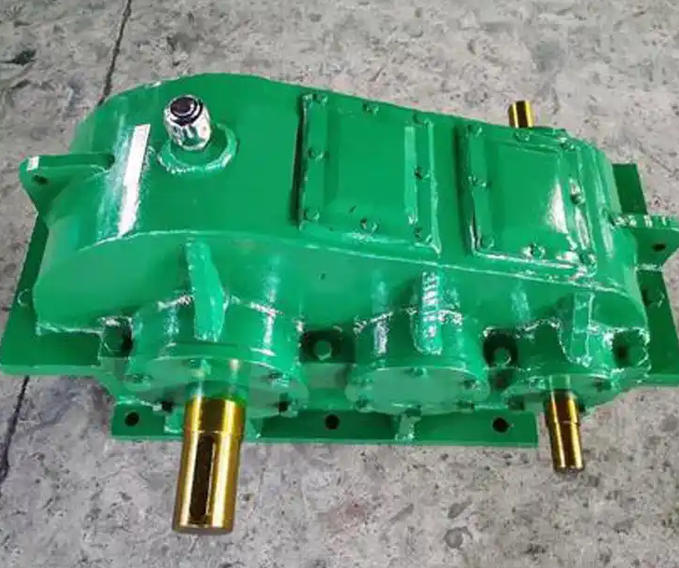
How to determine whether the noise of ZL75-31.5-1 soft tooth reducer is caused by damage to the gear body
1、 Step 1: Preliminary assessment through exclusive noise featuresThe noise caused by gear pair damage has clear and exclusive characteristics, which can be directly distinguished from other faults:
1. Periodic "click/clang" impact sound: The rhythm is strictly synchronized with the gear speed, and there are corresponding impacts per revolution, mostly pointing to tooth breakage and tooth surface collapse angle, which is a typical signal of damage to the gear pair of the soft tooth surface reducer.
2. Continuous "rustling/rough friction sound": accompanied by a rapid increase in oil temperature, it is clearly audible when unloaded, and the friction sound intensifies significantly after loading, corresponding to uniform wear and pitting on the tooth surface, resulting in rough meshing surface.
3. High frequency "whistling/hissing sound": becomes sharp and piercing as the speed increases, often caused by local meshing scratches due to tooth surface adhesion and tooth deviation. Soft tooth surface reducers are prone to occur after long-term overload.
2、 Step 2: Verify the variation pattern of working conditions
The noise caused by damage to the bearing surface of the gear pair will exhibit specific variation patterns with load and speed, which is the key to distinguishing other faults:
1. If the abnormal noise still exists when the gearbox is unloaded and the noise volume and vibration amplitude increase synchronously after loading, the damage to the bearing surface of the gear pair can be basically locked by testing the machine separately without external load.
2. If the noise is weak when unloaded, and the abnormal noise suddenly amplifies after loading, accompanied by a noticeable tingling vibration of the machine body, it indicates that the damage points on the gear meshing surface are exacerbated by the impact after being subjected to force, which belongs to the typical wear/pitting characteristics of gear pairs.
3. Excluding the situation of "no-load noise and disappearance after loading", such abnormal noise is mostly due to assembly clearance issues and does not belong to structural damage of the gear pair itself.
3、 Step 3: Use instruments to accurately locate the sound source
Use tools to further lock in noise coming from gear pairs, rather than bearings or other parts:
1. Screwdriver listening method: Place the screwdriver head in the middle of the gearbox housing (corresponding to the gear meshing area), and listen with your ears close to the handle. If the impact and friction sounds at this position are much greater than those at the bearing seats at both ends, it indicates that the sound source core is in the gear pair area.
2. Vibration spectrum analysis: If the amplitude of the gear meshing frequency in the spectrum significantly exceeds the standard, and there are "comb shaped" modulation sidebands with the gear shaft rotation frequency as the interval, the high-frequency noise floor noise is significantly increased, and it can be directly determined that the gear pair has wear, pitting, and other damage; If the spectrum highlights the characteristic frequency of the bearing, it indicates a bearing fault.
3. Measure the horizontal vibration value of the bearing seat. If the horizontal vibration is much greater than the vertical vibration and the value exceeds 5mm/s, it is highly likely that the vibration is caused by abnormal gear meshing rather than bearing failure.
Related News