
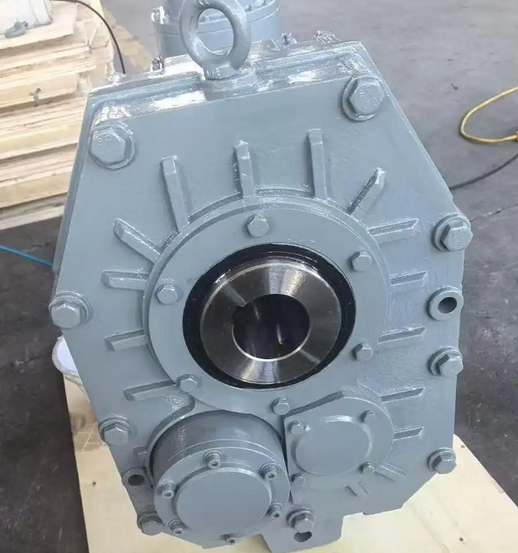
What should I do if the vibration frequency of ZDY280-5.6 gear reducer exceeds the standard
The vibration frequency of the ZDY280-5.6 gear reducer exceeds the standard. It is recommended to investigate in the order of "external first, internal second, soft first, hard second", prioritize verification of installation and alignment, then combine spectrum positioning of internal components, and finally perform lubrication and working condition verification to quickly reduce vibration.Step 1: Quick Calibration and Limit Verification
1. Measurement specification: According to ISO 10816-3, measure the RMS of horizontal/vertical/axial vibration velocity at the bearing seat, and record the time-domain waveform and spectrum.
2. Limit reference:
Good: ≤ 2.8 mm/s;
Attention: 2.8-4.5 mm/s (to be monitored);
Danger:>7.1 mm/s (stop immediately).
3. Frequency characteristic quick judgment:
1 × frequency conversion: mostly due to imbalance, axis bending, or poor alignment;
2 × frequency conversion: commonly seen in misalignment and mechanical looseness;
Mesh frequency and sidebands: pointing towards gear wear/pitting/tooth breakage;
High frequency (>1 kHz): mostly due to damage to the bearing raceway/cage.
Step 2: External and installation troubleshooting (fastest effect)
1. Foundation and foundation:
Check for loose/broken anchor bolts, use a torque wrench to tighten them to the specified torque (approximately 35-40 N · m for M12 bolts), and install anti loosening washers.
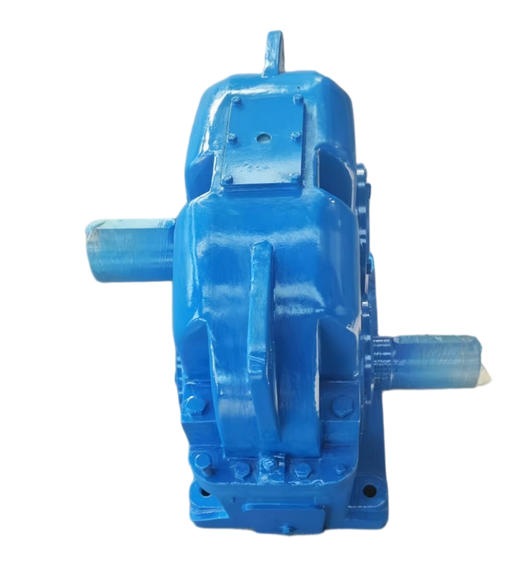
When the stiffness of the base is insufficient, weld reinforcement bars or thicken the bottom plate, with a levelness of ≤ 0.2 mm/m.
2. Coupling and alignment:
Check the wear of the elastic block/membrane and replace the aging parts.
Use a dial gauge to calibrate coaxiality: radial runout ≤ 0.05 mm, angular deviation ≤ 0.1 °. If it exceeds the tolerance, adjust the motor position.
3. Resonance verification:
Measure the trend of vibration variation with speed. If the amplitude of a certain speed range suddenly increases, resonance is determined, and the foundation stiffness needs to be adjusted or the operating speed needs to be changed.
Step 3: Internal component diagnosis (spectrum positioning)
1. Gear malfunction:
The frequency spectrum exhibits meshing frequencies and sidebands, or an increase in the amplitude of harmonics (2 ×, 3 ×), accompanied by abnormal roaring/impact sounds.
Processing: Check the contact spots (≥ 70%) using the coloring method, adjust the side clearance (0.1-0.3 mm, according to the modulus); Wear/pitting/tooth breakage require gear replacement to ensure that the grinding accuracy meets the standard.
2. Bearing malfunction:
High frequency occurrence of bearing characteristic frequencies (BPFO/BPFI) and harmonics, temperature rise>40 ℃ or metal friction sound upon auscultation.
Solution: Replace the matching bearing model (such as SKF/NSK), standardize the press fit, and avoid knocking; Adjust the clearance (controlled by shims for tapered roller bearings).
Related News