
Precautions for the application of RF57-5.05-3KW reducer in the chemical industry
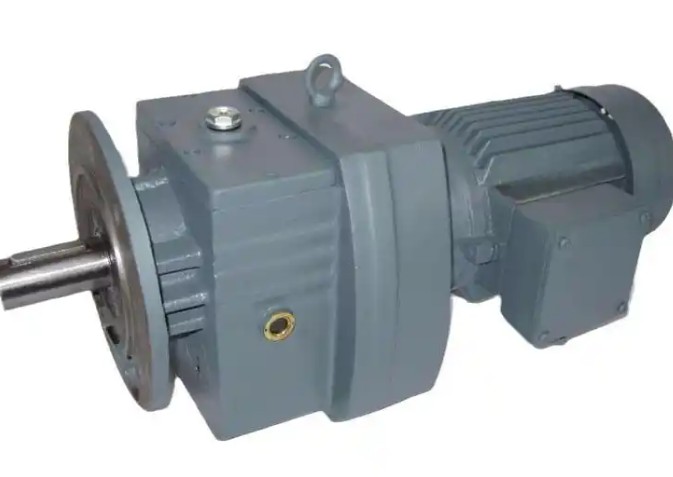
The RF57-5.05-3kW reducer belongs to the R series hard tooth helical gear reducer, which is compatible with 3kW motors and has a reduction ratio of 5.05. It has the characteristics of compactness, high efficiency, and impact resistance. It is widely used in the chemical industry as a transmission system for small mixing tanks, metering pumps, powder conveyors, and additive proportioning devices. Due to the presence of corrosive media, dust, flammability, explosiveness, high and low temperatures, and other special working conditions in the chemical industry, the following precautions should be taken during application:1. Corrosion prevention and sealing strengthening
Chemical workshops often contain acidic and alkaline vapors, corrosive dust, and solvent volatiles, which can accelerate the corrosion of the gearbox body and shaft head, and may also infiltrate the gearbox and contaminate the lubricating oil.
Before installation, the surface of the gearbox box should be sprayed with acid and alkali resistant anti-corrosion paint, and a double-layer skeleton oil seal and dust ring should be installed on the exposed part of the shaft head to prevent corrosive media from entering;
If used for mixing acidic and alkaline materials and conveying corrosive powders, it is recommended to use stainless steel shaft heads and fasteners to avoid component corrosion and failure;
Regularly check the sealing of the oil seal, replace it promptly if oil leakage or damage is found, and prevent corrosive liquids from entering the gearbox and causing gear pitting.
2. Explosion proof and electrical matching specifications
If applied to the working conditions of flammable and explosive media (such as solvent mixing, oil and gas recovery, and flammable powder transportation), strict explosion-proof requirements must be followed:
The matching motor must be selected with the corresponding explosion-proof level (such as Ex d Ⅱ B T4), and ordinary motors are prohibited to avoid explosions caused by motor sparks;
The connecting flange between the reducer and the motor needs to be equipped with anti-static jumper wires to eliminate static electricity generated during the transmission process and prevent the accumulation of static electricity from igniting flammable and explosive gases;
The installation location should be far away from the discharge outlets and leakage points of flammable and explosive media, while ensuring reliable equipment grounding and grounding resistance in accordance with chemical safety regulations.
3. Special adaptation of lubrication system
Chemical equipment often operates under high and low temperature conditions, as well as continuous long-term operation. Ordinary gear oil cannot meet the demand, and it is necessary to adjust the lubrication plan accordingly
High temperature working conditions (such as reaction kettle heat tracing and drying equipment matching): High temperature synthetic gear oil (such as VG320 synthetic hydrocarbon oil) is selected, which has strong resistance to high temperature and oxidation, avoiding lubricating oil carbonization at high temperature and blocking the oil circuit; Low temperature working conditions (such as low-temperature refrigerant mixing): Use low-temperature gear oil (such as VG150 low-temperature hydraulic oil) to prevent transmission jamming caused by low-temperature solidification of lubricating oil;
The equipment needs to be replaced with new oil after 500 hours of initial operation, and then every 2000 hours or 6 months thereafter; If there is a risk of dust and corrosive media intrusion in the working conditions, the oil change cycle should be shortened to 1500 hours;
When refueling, impurities should be filtered out, and the gearbox oil level should be kept at the center line of the oil gauge to avoid high oil level causing oil temperature rise and low oil level causing insufficient lubrication.