
What are the low-temperature protection measures for NGW123-560-1 planetary gearbox
NGW123-560-1 belongs to the category of high torque heavy-duty planetary reducers, which are commonly used in heavy load conditions such as metallurgy, mining, and heavy-duty transportation. In low-temperature environments, protection measures need to be implemented from five dimensions: material strengthening, lubrication temperature control, structural protection, start-up and operation control, and monitoring and early warning. Specifically, the following six core measures can be listed:1. Low temperature material upgrade and heat treatment strengthening of core transmission components
The 20CrMnTi carburized steel gears and gray cast iron casing of this model, which are commonly configured, have significantly reduced toughness in low temperature environments below -10 ℃, and are prone to brittle failure problems such as tooth surface chipping and casing cracks. For low-temperature working conditions, core components such as the sun gear, planetary gear, and internal gear ring need to be upgraded to 20CrNiMoA or 42CrMo low-temperature resistant alloy steel, and a composite heat treatment process of "carburizing quenching+low-temperature tempering" should be adopted. The tempering temperature should be controlled at 180-220 ℃, which can significantly improve the low-temperature impact toughness of the material (impact energy Ak ≥ 47J, no brittle transformation at -40 ℃). The box body needs to be replaced with ductile iron QT500-7, replacing ordinary gray cast iron. Ductile iron has stronger low-temperature crack resistance and deformation resistance, and can withstand heavy impact at low temperatures; At the same time, low-temperature stress relief treatment is carried out on structural components such as planetary carriers and output shafts, and welding or forging residual stresses are reduced through aging annealing to avoid deformation and cracking caused by stress concentration at low temperatures. Fasteners should use 12.9 grade high-strength low-temperature bolts, matched with anti loosening washers, to prevent bolt loosening caused by low-temperature shrinkage.
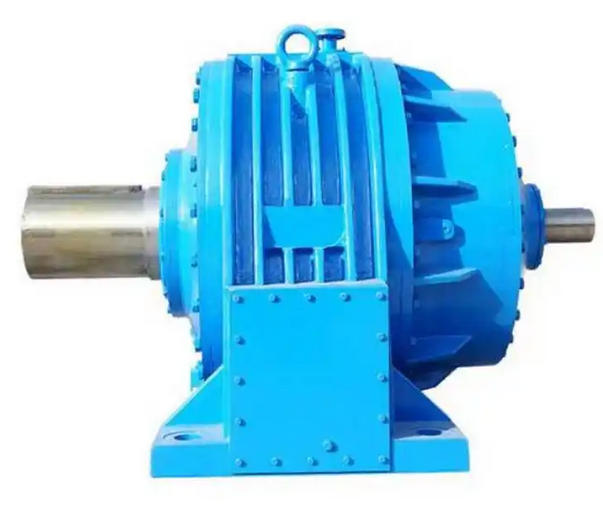
2. Low temperature and constant temperature control of lubrication system and oil adaptation
The sudden increase in viscosity of lubricating oil under low temperature environment is the core cause of starting wear and component brittleness of this model, and a three-level lubrication protection system of "oil adaptation+constant temperature heating+circulation guarantee" needs to be constructed. Firstly, abandoning conventional mineral gear oil, PAO poly - α - olefin fully synthetic low-temperature gear oil is selected, with a recommended viscosity grade of ISO VG 150. Its pour point is as low as -45 ℃ or below, and it can still maintain good fluidity in a low temperature environment of -40 ℃. At the same time, it has excellent extreme pressure and anti-wear performance, which can meet the lubrication needs of heavy-duty meshing. Secondly, install an oil circuit constant temperature heating system for the reducer, including an oil tank electric heating rod (power matched according to the oil tank volume, usually 2-3kW) and an oil temperature sensor. The oil temperature is stably controlled at 15-25 ℃ through a thermostat to ensure that the oil quickly forms an effective oil film with a thickness of ≥ 10 μ m during startup; The outer side of the box needs to be wrapped with a 50mm thick polyurethane insulation layer to reduce heat loss. In addition, it is necessary to optimize the design of the lubrication pipeline, add a bypass circulation pump, and start the circulation pump every 2 hours for 5 minutes during low-temperature shutdown to prevent oil settling and layering, ensuring even distribution of oil at each lubrication point.
Related News