
How to prevent gear fracture of ZLYJ hard tooth surface reducer
1. Optimize design and manufacturing processesMaterial and heat treatment optimization: Select high-strength and high toughness alloy steel materials (such as 20CrMnTi, 42CrMo, etc.). By using heat treatment processes such as carburizing, quenching, and carbonitriding, the tooth surface can achieve high hardness (such as HRC 58-62) to improve wear and compression resistance, while maintaining core toughness and preventing brittle fracture.
Strengthening of tooth root structure: increasing the fillet radius of the tooth root and optimizing the transition curve to effectively reduce stress concentration in the tooth root area.
Surface strengthening treatment: Shot blasting, rolling and other processes are used to strengthen the surface layer of the tooth root, introducing residual compressive stress to significantly improve the fatigue resistance of the gear and reduce the probability of fatigue fracture.
High precision machining: Adopting a three-stage process of "coarse rolling teeth+fine rolling teeth+grinding teeth" to ensure that the tooth profile is regular and the meshing clearance is uniform, so as to balance the force during the transmission process and avoid local overload.
2. Standardized installation and assembly
Ensure axis alignment: During installation, high attention should be paid to the alignment of the transmission center axis, and the error should not exceed the compensation amount of the coupling used. Good alignment can avoid generating additional force and prolong the service life.
Violent tapping is strictly prohibited: When installing transmission components on the output shaft, it is absolutely not allowed to use a hammer to strike. Assembly fixtures and shaft end internal threads should be used to smoothly press the transmission components in with bolts to avoid damaging the internal parts of the gearbox.
Reasonable selection of couplings: Try to avoid using rigid fixed couplings as much as possible. If this type of coupling is not installed properly, it can cause unnecessary external loads, leading to early damage to the bearings, and in severe cases, even causing the output shaft to break.
Installation of anti torque bracket: The anti torque bracket should be installed on the side of the reducer facing the working machine, and rubber or other elastic materials should be used at the connection end with the fixed support to absorb torque fluctuations and reduce additional bending moments.
3. Scientific lubrication and daily maintenance
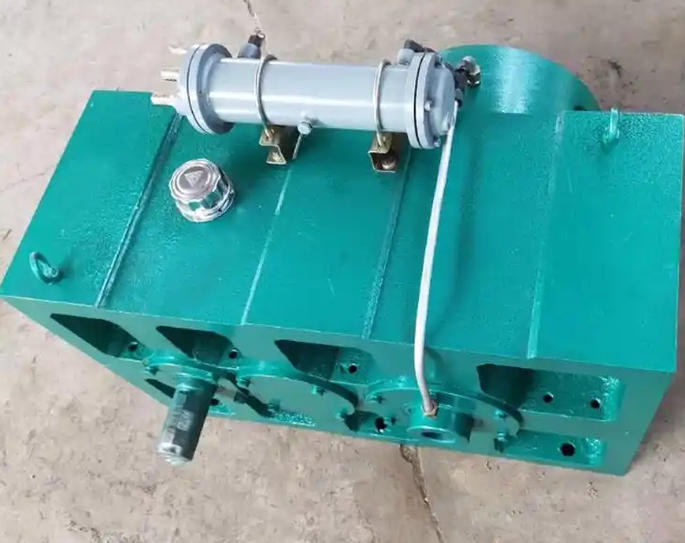
Ensure lubrication quality: ZLYJ reducers usually use oil pool immersion and splash lubrication (large size with forced circulation). Suitable lubricating oil (such as N220 extreme pressure gear oil) should be selected, and the oil level and quality should be checked regularly to prevent increased friction on the tooth surface due to low viscosity, failure, or impurities and moisture in the lubricating oil.
Pay attention to the ambient temperature: When the ambient temperature is below 0 ℃, an electric heating tube should be added to the oil tank to preheat the lubricating oil; When the ambient temperature is too high, thermal balance calculations should be performed and consideration should be given to adding cooling devices.
Strengthen operation monitoring: Regularly inspect the gearbox, closely monitor the operation sound, vibration, and temperature. If it is found that the operation is unstable, there is impact vibration, noise or abnormal temperature rise, the machine should be stopped in time for investigation to prevent the expansion of hidden dangers.
Standardized operation: Operators should strictly follow the regulations when using equipment, avoid illegal operations such as reverse braking, and prevent gears from bearing instantaneous excessive impact loads.