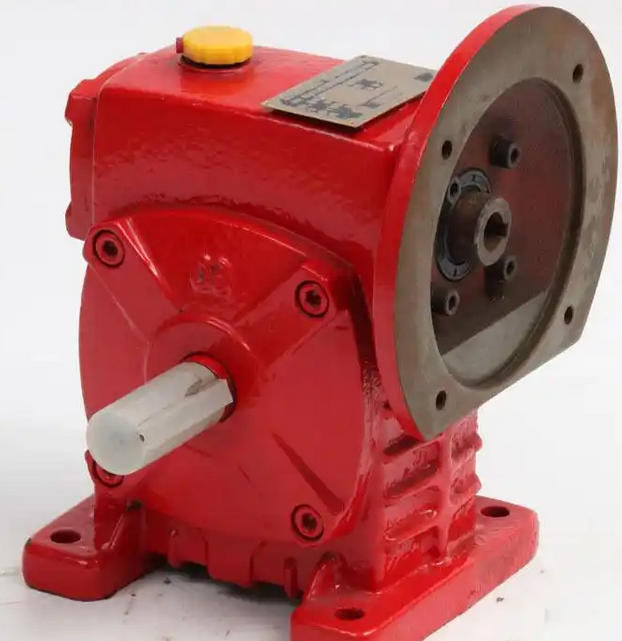

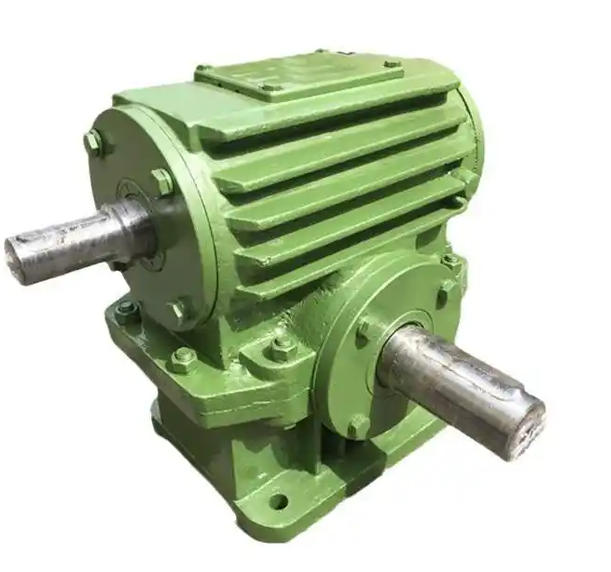
How to determine whether the abnormal noise in the TP series worm gear reducer is caused by bearing failure
1. Listen to sound characteristics (acoustic diagnosis)The normal meshing sound of a turbine worm is usually a uniform and low "rustling" sound. If you suspect a bearing issue, you can use a listening stick or screwdriver to press against the end cover of the bearing seat and listen carefully. Bearing damage usually exhibits the following typical abnormal sounds:
High frequency whistling or sharp whistling: Excessive clearance between the bearing rolling elements and the raceway, or lubrication failure leading to direct metal friction, will produce high-frequency noise that increases with the increase of speed.
Regular metal tapping sound: Similar to the "clang clang" sound of a small hammer tapping regularly, the rhythm is synchronized with the shaft speed, which is usually a characteristic of bearing inner ring peeling or damage.
Irregular stuttering sound: Deformation or damage to the cage can cause the rolling elements to move poorly, producing irregular "click" or "clack" sounds.
Continuous piercing friction sound: Severe peeling of the inner and outer rings of the bearing causes the rolling elements to jam, resulting in continuous metal friction sound.
2. Measure temperature changes (thermal diagnosis)
Bearing damage can cause abnormal temperature rise due to increased friction. Infrared thermometers can be used to monitor the temperature on the surface of the bearing end cap
Normal standard: The surface temperature of the bearing end cap should usually be ≤ ambient temperature+40 ℃.
Abnormal judgment: If the hand feels hot and cannot stay for more than 3 seconds, or the temperature exceeds 70 ℃, it indicates that the bearing may have lubrication failure, rolling element deformation, or jamming.
3. Check the vibration situation (vibration diagnosis)
Bearing damage can disrupt the rotational balance of the equipment and cause significant vibrations. You can use a vibration measuring pen or vibration analysis app for testing:
Normal standard: The normal vibration amplitude is usually ≤ 0.1mm (without visible shaking to the naked eye).
Abnormal judgment: When the bearing is damaged, the vibration amplitude often exceeds 0.3mm, and a clear peak at the same frequency as the worm gear speed will be displayed in the frequency spectrum analysis.
4. Check the condition of the oil (microscopic evidence)
Early signs of bearing wear are often reflected in the lubricating oil. You can take a small amount of oil droplets from the gearbox and observe them on white filter paper or glass
Metal debris: If black or silver particles that can be adsorbed by magnets are found, it indicates that the rolling elements or inner and outer rings of the bearing have worn and peeled off; If there are strip-shaped metal shavings with a length exceeding 1mm, it is a typical characteristic of bearing cage fracture.
Emulsification of oil: If the oil appears milky white (similar to milk), it indicates that the seal has failed and water has entered, and the bearing may have rusted.
Related News