
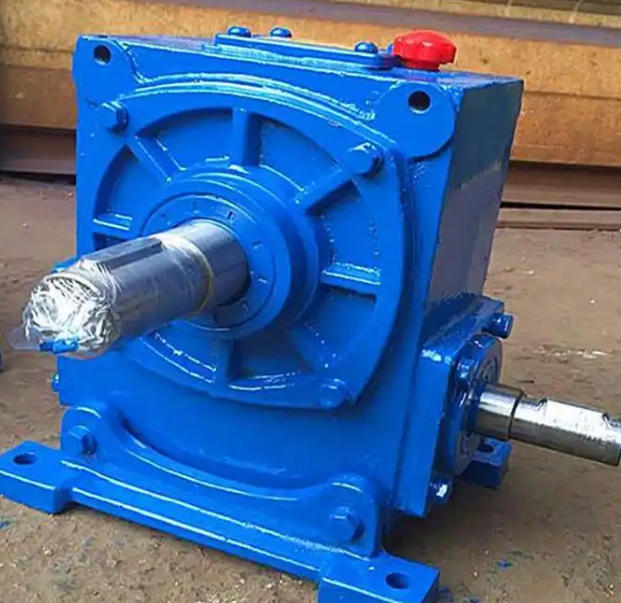
What are the common errors when installing WHX160-31.5-IF worm gear reducer
The most common errors when installing WHX160-31.5-IF worm gear reducer are concentrated in insufficient centering accuracy, improper bolt tightening, neglect of lubrication and sealing inspection, and installation environment not meeting standards. These errors may seem small, but they can easily cause vibration, temperature rise, oil leakage, and even early damage to bearings or gears, seriously affecting equipment life and operational stability.1、 Excessive deviation in alignment: the most common and harmful error
Error manifestation: Only roughly aligning the motor and reducer shaft with the naked eye or ruler, without using a dial gauge or laser alignment instrument for measurement.
Actual impact: Inconsistent shaft systems can cause uneven stress on the coupling, exacerbate bearing wear, generate periodic vibrations and abnormal noise, and long-term operation may lead to shaft fracture.
The correct approach:
Measure radial and axial deviations using a laser alignment instrument or dual meter method.
Control radial runout ≤ 0.05mm and axial deviation ≤ 0.1mm/m.
Considering thermal expansion compensation, the input end of the gearbox can be slightly lower than the motor end by 0.1-0.2mm during cold installation.
2、 Improper bolt tightening: causing structural deformation and loosening
Error manifestation:
Tighten all anchor bolts or flange bolts directly at once.
Not tightened in diagonal order, resulting in uneven stress on the box.
The tightening torque is too high (causing slippage) or too low (loosening after operation).
Actual impact: The deformation of the box will change the meshing state of the worm gear and worm, causing eccentric load wear; Loose bolts may cause equipment displacement or even detachment.
The correct approach:
Use a torque wrench to tighten in a "cross cross, incremental" manner.
Completed in three stages: pre tightening (30% torque) → semi tightening (70%) → final tightening (100% specified value).
The WHX160 model commonly uses M24 anchor bolts, and the recommended final tightening torque is 350-420N · m. Please refer to the manufacturer's manual for details.
3、 Neglecting lubrication and oil level inspection: directly threatening transmission life
Error manifestation:
Not checking the lubricating oil level after installation, and even forgetting to add oil.
Using the wrong type of lubricating oil (such as replacing specialized L-CKD 220 extreme pressure gear oil with regular engine oil).
The oil level is too high (increasing stirring heat) or too low (insufficient lubrication).
Actual impact: Worm gear transmission involves sliding friction, generates a large amount of heat, and poor lubrication can quickly lead to tooth surface adhesion and bearing burnout.
The correct approach:
Confirm that the specified type of lubricating oil has been added before installation.
The oil level should be controlled at the centerline of the oil gauge or 2/3 of the viewing window.
After running the new machine for 400 hours, the lubricating oil must be replaced and the metal particles during the break in period must be removed.