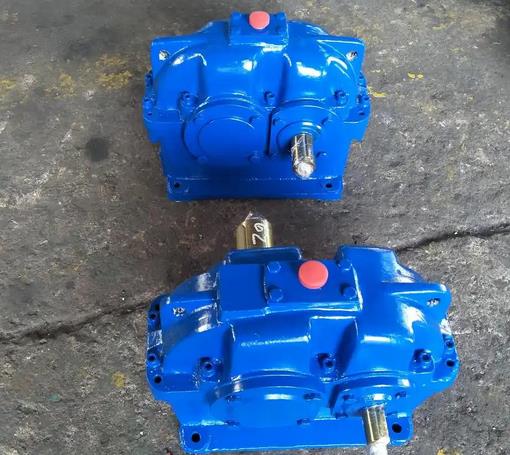

What methods can be used to reduce the noise and vibration of ZLYJ250-12.5-2 reducer
1、 Gear source optimization (eliminating incentives from the source)Tooth profile modification treatment: perform tooth top modification (0.05-0.1mm) and drum shaped tooth modification on the gear to compensate for load deformation, significantly reduce meshing impact, and reduce noise by 2-4dB (A).
Accuracy and parameter upgrade: Improve gear accuracy to level 6 of GB/T 10095, control tooth surface roughness Ra ≤ 0.8 μ m; By increasing the number of teeth and optimizing the helix angle while meeting the strength requirements, the meshing coincidence is improved, resulting in a smoother transmission.
Pairing process optimization: Adopting 20CrMnTi carburizing and quenching gears, the hardness of the small gear tooth surface is 20-30HB higher than that of the large gear, and the running in process automatically adapts to the meshing clearance to reduce wear and noise.
2、 Installation and foundation vibration reduction (to prevent abnormal vibrations caused by assembly)
Precision shaft alignment: Use a laser alignment instrument to calibrate the coaxiality of the input/output shaft to ≤ 0.05mm, and the radial deviation of the coupling to ≤ 0.1mm, to avoid periodic impact vibration caused by unbalanced load.
Basic rigidity strengthening: pour C25 or above concrete base (thickness ≥ 300mm), use 8.8 grade anchor bolts and tighten them according to the specified torque; Install rubber shock absorbers with a Shore hardness of 60-70 between the reducer and the base, with compression controlled at 10% -15%, which can block 25% -40% of vibration transmission.
Bearing system calibration: C3 clearance precision bearings are selected, and the axial preload is controlled at 0.05-0.1mm to eliminate shaft oscillation caused by clearance and reduce bearing vibration and abnormal noise.
3、 Optimization of lubrication system (reducing meshing friction noise)
Accurate oil selection: Select ISO VG 320 extreme pressure synthetic gear oil, add MoS ₂ anti-wear additive, form a stable oil film on the tooth surface, avoid direct metal dry friction, and reduce noise by 2-3dB (A).
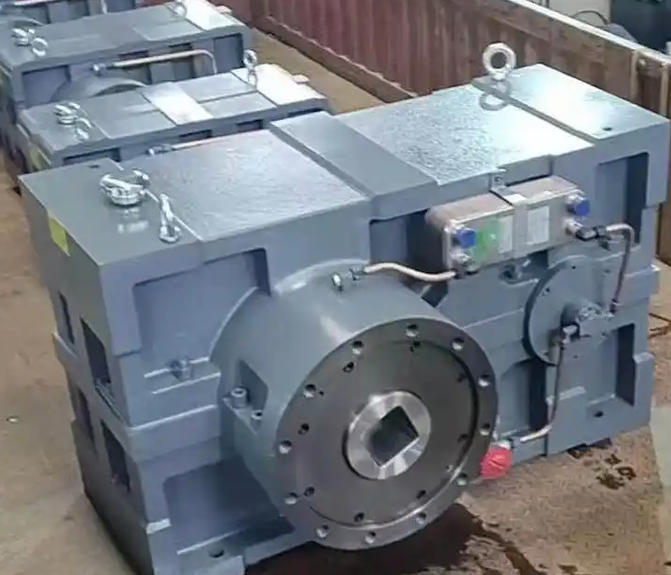
Oil level and cleanliness control: The oil level should be controlled at the center line of the oil gauge, only covering 1-2 tooth heights, to avoid mixing noise caused by excessive oil level; Change the oil every 2000 hours to ensure that the oil particle contamination level is ≤ ISO 17/14, to prevent abrasive particles from exacerbating tooth surface wear.
4、 Blocking the box and propagation path (suppressing noise radiation)
Box stiffness upgrade: Strengthening ribs are added at the center of the bearing seat and panel to optimize the modal frequency of the box and avoid the resonance range of the working speed, suppressing the bending vibration radiation noise of the box.
Damping and sound insulation treatment: 20-30mm thick polyurethane sound-absorbing foam is pasted on the inner wall of the box, and nitrile rubber damping layer is pasted on key positions, which consumes vibration energy and can reduce noise by 3-5 dB (A).
Load condition adaptation: Avoid long-term overload operation exceeding 120% of the rated torque, monitor the operating current and temperature rise, ensure smooth operation of the equipment within the design condition range, and prevent vibration intensification caused by plastic deformation of the tooth surface.
Related News