
How to choose the gear accuracy level of a soft tooth surface reducer
The gear accuracy level of soft tooth surface reducers is usually selected as 8-9 levels (GB/T 10095), which can be increased to 7 levels in working conditions with high requirements for noise and smoothness. This choice requires a comprehensive consideration of transmission performance, cost control, and operating environment, taking into account manufacturing feasibility and long-term maintenance needs.1、 Key factors affecting the selection of accuracy level
1. Transmission performance requirements
Low noise target: The higher the precision, the more uniform the gear meshing contact, which can significantly reduce mid to high frequency noise. The effect is better when the coincidence degree is ≥ 1.2.
2. Manufacturing and maintenance costs
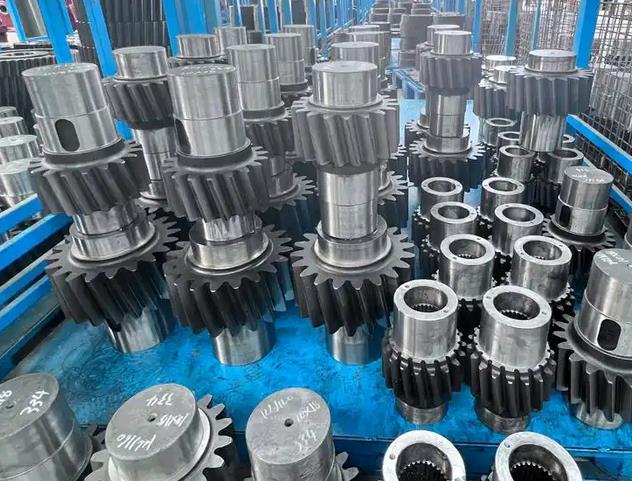
Soft tooth surface gears generally do not undergo carburizing, quenching, and grinding processes. The 8-level precision can be achieved through ordinary gear hobbing, and the cost is controllable.
If it is upgraded to level 7, precision cutting or gear grinding processes need to be added, which increases processing costs by about 20% -30%, but can extend the oil change cycle and the overall machine life.
3. Heat treatment and deformation control
Soft tooth surface gears are often treated with quenching or normalizing, resulting in minimal deformation and suitable for direct control of 8-level precision.
If there are minor trimming processes (such as gear shaving) in the future, it can further stabilize the 7-level accuracy level.
Related News