
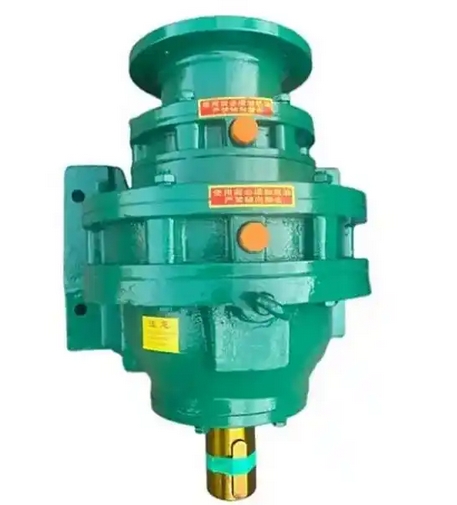
What are the structural components of planetary gear reducers
Due to structural reasons, the minimum single-stage reduction of planetary reducers is 3, and the maximum is generally not more than 10. The common reduction ratio is 3.4.5.6.8.10, and the number of reducer stages generally does not exceed 3. However, some customized reducers with large reduction ratios have 4 stages of reduction. Compared to other reducers, planetary reducers have the characteristics of high rigidity, high precision (up to 1 point per stage), high transmission efficiency (97% -98% per stage), high torque/volume ratio, and lifetime maintenance free.The maximum rated input speed of the reducer can reach 18000rpm (depending on the size of the reducer itself, the larger the reducer, the lower the rated input speed). The output torque of industrial grade planetary reducers generally does not exceed 2000Nm, and specially designed ultra high torque planetary reducers can achieve over 10000Nm. The working temperature is generally around -25 ℃ to 100 ℃, and its working temperature can be changed by changing the lubricating grease.
Grade: The number of sets of planetary gears Due to the inability of one set of planetary gears to meet larger transmission ratios, sometimes 2 or 3 sets are needed to meet the requirement of supporting larger transmission ratios Due to the increase in the number of planetary gears, the length of the 2nd or 3rd stage gearbox will increase and the efficiency will decrease.
Return clearance: When the output end is fixed and the input end rotates clockwise and counterclockwise to generate a rated torque of+-2%, there is a slight angular displacement at the input end of the reducer, which is the return clearance The unit is' fen ', which is one sixtieth of one degree. Some people also call it a back gap.
Planetary cycloidal pinwheel reducer: The entire transmission device can be divided into three parts: input part, reduction part, and output part. A double eccentric sleeve with a 180 ° misalignment is installed on the input shaft, and two roller bearings called rotating arms are installed on the eccentric sleeve to form an H mechanism. The center holes of the two cycloidal gears are the raceways of the rotating arm bearings on the eccentric sleeve, and the cycloidal gears mesh with a set of annular arranged needle teeth on the needle gear to form an internal meshing reduction mechanism with a tooth difference of one tooth (in order to reduce friction, needle teeth are equipped with needle tooth sleeves in reducers with low speed ratios). When the input shaft rotates one revolution with an eccentric sleeve, due to the characteristics of the tooth profile curve on the cycloid gear and its restriction by the needle teeth on the needle gear, the motion of the cycloid gear becomes a planar motion with both revolution and rotation, when the input shaft rotates in the forward direction.