
How to determine whether the tightening of the foundation bolts of BWED121-391-1.5KW cycloidal reducer meets the standard
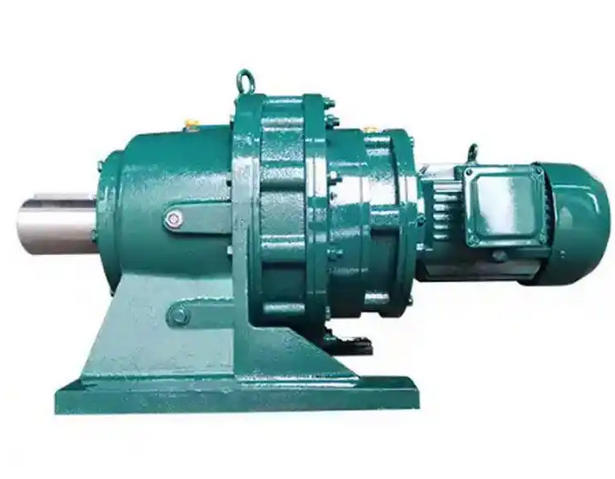
For the BWED121-391-1.5KW two-stage cycloidal pinwheel reducer, it is not enough to rely solely on hand feel to determine whether the tightening of the anchor bolts meets the standard. A comprehensive judgment must be made by combining torque value retesting, contact surface clearance detection, and operational vibration monitoring. The most direct standard for compliance is that the bolt torque reaches the rated value (usually the M12-M14 specification is in the range of 25-45N · m, depending on the bolt grade) and the attenuation is ≤ 5%. At the same time, a 0.05mm feeler gauge cannot be inserted between the base and the foundation.1. Static torque retest (core quantitative indicator)
This is the most direct basis for determining whether the tightening meets the standard, and a calibrated torque wrench needs to be used for operation.
Standard value: The supporting anchor bolts for BWED121 models are usually M12 or M14 specifications (8.8 grade high-strength bolts). Referring to the standard of similar 1.5KW models, the rated tightening torque is usually between 25-45N · m (please refer to the accompanying manual for details, if there is no manual, M12 recommends 30-40N · m, M14 recommends 45-55N · m).
Testing method: Adopting a combination of "random inspection+full inspection". Set the torque wrench to 95% -100% of its rated value and apply force slowly. If the wrench does not make a "click" sound and the bolt does not rotate, it is considered to meet the standard; If it sounds before easily rotating or reaching the preset value, it indicates insufficient preload force.
Uniformity requirement: The torque deviation of the same group of bolts should be controlled within ± 5% to avoid excessive force on one side causing the machine base to warp.
2. Contact surface gap detection (to prevent virtual tightness and deformation)
The purpose of tightening bolts is to ensure a tight fit between the machine base and the foundation, and any gap is a signal of non-compliance.
Plug gauge testing method: Use a 0.05mm precision plug gauge and attempt to insert it into the gaps around the anchor bolt, between the bottom surface of the machine base and the foundation (or shim).
Standard for compliance: The insertion depth of the feeler gauge shall not exceed one-third of the width of the shim or machine base, and the ideal state is that it cannot be inserted at all.
Common misconception: It is strictly prohibited to eliminate gaps by forcibly tightening bolts, as this can cause deformation of the machine base. If the gap exceeds the standard, the bolts must be loosened, the thickness of the shim must be readjusted, or the foundation must be polished.
Fit of pad iron: Check whether each group of pad iron (usually 4 groups, corresponding to 4 bolts) is centrally arranged and the number of layers does not exceed 2. Multilayer stacking or bias can lead to uneven force distribution, which will inevitably loosen after long-term operation.
Related News