
How to determine the model and specifications of ZDY single-stage cylindrical gear reducer
The specification determination of ZDY single-stage cylindrical gear reducer is a comprehensive process that requires compliance with national standards (such as JB/T8853-2001) and calculation and selection based on specific working conditions.Simply put, specification determination can be divided into two levels: one is to understand the meaning of the model, and the other is to calculate and select based on application requirements.
1、 Understand the meaning of the model
A complete ZDY gearbox model usually consists of information such as series code, specifications, transmission ratio, and assembly form.
Taking ZDY 280-5-I as an example:
ZDY: Represents the single-stage cylindrical gear reducer series. Among them, "Z" represents cylindrical gear, "D" represents single-stage, and "Y" represents hard tooth surface.
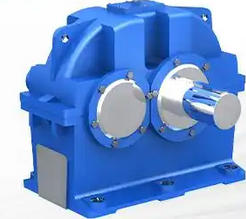
280: represents the center distance of the reducer, measured in millimeters (mm). This is a key dimension for measuring the size and load-bearing capacity of a gearbox.
5: Represents the nominal transmission ratio, which is the ratio of input speed to output speed.
I: Representing the assembly form, it refers to the position and direction of the input/output shaft.
2、 How to determine specifications based on requirements
The specific specifications need to be determined based on your actual usage scenario, through the following three core steps:
1. Determine the specifications and models (based on power and transmission ratio)
Firstly, the following operating parameters need to be collected:
Prime mover parameters: power (P ₁) and speed (n ₁) of the electric motor.
Working machine parameters: required working machine power (P ₂) and speed (n ₂), or directly determine the required transmission ratio (i=n ₁/n ₂).
Working conditions: daily working hours, number of starts per hour, load characteristics (stable, with impact, etc.).
Calculate the calculated power (Pc) based on these parameters. The calculated power is equal to the working machine power (P ₂) multiplied by a comprehensive coefficient (K), which includes the utilization coefficient (KA), start-up coefficient (KS), and reliability coefficient (KR).
Pc = P₂ × KA × KS × KR
Then, based on the calculated power (Pc) and the required transmission ratio (i), refer to the manufacturer's selection manual or power meter to find the corresponding specification where the rated input power (PA) is greater than the calculated power (Pc). For example, if the calculated power is 526.5 kW and the transmission ratio is 4.5, it may be determined to choose the ZDY315 specification after checking the table.
2. Verify thermal power (heat dissipation capacity)
The reducer generates heat during operation, and its heat dissipation capacity must be ensured to meet the requirements. The allowable thermal power (Pa) provided by the manufacturer is usually measured under standard conditions (such as 20 ℃).
If your actual operating environment temperature is higher and the continuous operation time is longer, you need to adjust the allowable thermal power. If it is found after verification that the actual thermal power demand exceeds the natural cooling capacity of the gearbox, it is necessary to choose a model with auxiliary cooling devices, such as installing fans or circulating oil cooling coils.
Related News