
What are the effects of heat treatment process deformation on the XWD8190-43-11KW reducer cycloidal gear on the equipment
The heat treatment deformation of XWD8190-43-11KW cycloidal gear (commonly GCr15 vacuum quenching, 20CrMnTi carburizing quenching) can lead to poor meshing, increased vibration and noise, decreased accuracy, accelerated wear, shortened service life, and in severe cases, tooth jamming or breakage, thereby affecting the reliability and production continuity of the whole machine.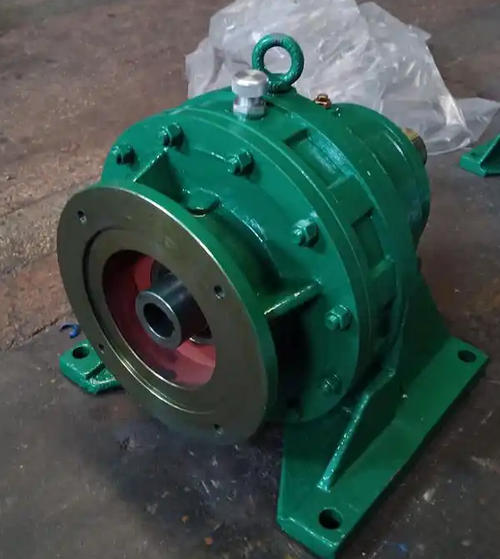
1. Core effects and typical manifestations: In terms of meshing and load-bearing, tooth profile distortion, tooth tip circular jumping, and end face warping can cause uneven contact, interference, and a decrease in the number of meshing teeth, leading to an increase in the peak contact stress and a higher risk of tooth surface peeling, tooth collapse, and increased impact load. In terms of accuracy and positioning, elliptical inner holes, end face warping, and excessive coaxiality can cause eccentric trajectory deviation, output jitter, positioning drift, decreased transmission accuracy, significant start stop impact, and accumulated servo/positioning system errors. In terms of vibration and noise, tooth profile errors, end face runout, and uneven clearance can cause howling, low-frequency vibration, abnormal temperature rise, noise often exceeding 80dB, premature failure of bearings and oil seals, and deterioration of the working environment. In terms of wear and lifespan, poor tooth contact, edge bearing, and uneven clearance can accelerate the wear and tear of the needle sleeve/pin and the tooth surface, leading to a vicious cycle of rapid expansion of clearance. The overhaul cycle is often shortened by more than 50%. In terms of assembly and interchangeability, poor consistency and inconsistent deformation of the double cycloid wheel can lead to assembly difficulties, phase angle deviations, uneven pre tightening, increased rework and batch failure rates, and poor interchangeability of maintenance spare parts.
2. The chain effect on the entire equipment: In terms of power and efficiency, the meshing loss increases, the temperature rise rises, and the efficiency decreases by 2% to 5%. When overloaded, it is easy to get stuck or trigger overload protection. Bearings and shaft systems will bear additional radial/axial forces, resulting in bearing raceway peeling, shaft shoulder wear, and oil seal lip tearing and leakage. In terms of structure and safety, the vibration of the box body intensifies, the loosening of the foundation bolts, the fatigue cracking of the connecting parts, and in severe cases, the cycloidal gear gets stuck or breaks teeth, causing equipment shutdown and even safety accidents. In terms of maintenance costs, the frequency of inspections, spare parts consumption, and downtime losses have all increased, and the proportion of rework/repair costs has significantly increased.
Related News