
The Impact of Gear Tooth Profile on Transmission Smoothness and Noise in the Cutting Machine's Reducer
1、 The influence mechanism of tooth profile on transmission smoothness and noise1. Tooth profile accuracy is the foundation
High precision tooth profile ensures smooth transition of gears during meshing, reducing impact and vibration. On the contrary, tooth profile errors (such as tooth profile deviation and tooth pitch error) can cause gears to collide at the moment of meshing and disengagement, producing periodic impact noise, which is one of the main sources of gearbox noise. Experiments have shown that gears with small tooth profile errors can produce noise that is 10dB lower than ordinary gears.
2. Tooth shape design is key
Tooth profile modification: Proper modification of the tooth top and root (such as drum machining, end cutting machining) can prevent gear teeth from being biased and contacting the edges due to force deformation or installation errors, making the load distribution more uniform and significantly reducing meshing impact and noise.
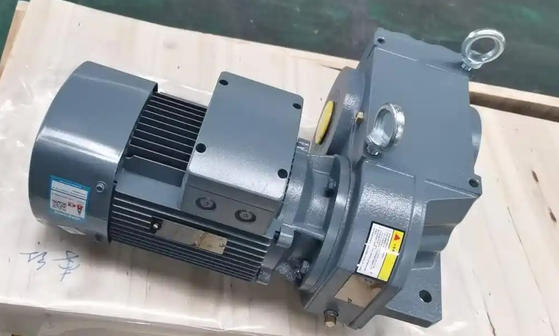
Advanced tooth profile: Using specially designed tooth profiles, such as 3D curved conjugate double arc tooth profiles, can increase the number of teeth meshing simultaneously, increase the contact area, make meshing deeper and smoother, effectively reduce noise and improve transmission rigidity from a design perspective.
Tooth profile type: Compared to spur gears, helical gears and herringbone gears gradually enter and exit meshing, resulting in smoother transmission and lower noise.
3. Tooth wear is the cause
Under long-term heavy load and frequent start stop conditions of the cutting machine, the gear tooth surface may experience wear, pitting, or plastic deformation, resulting in changes to the original tooth profile.
Increased meshing clearance: Wear can cause the tooth flank clearance to exceed the design value, resulting in noticeable impact sounds during reversing or load changes.
Abnormal contact spots: Changes in tooth shape lead to a decrease in meshing contact area, local stress concentration, which not only exacerbates wear but also causes severe vibration and noise.
Vicious cycle: The vibration and impact caused by the deterioration of tooth profile will further accelerate the damage of gears and bearings, forming a vicious cycle of "increased noise - increased wear - increased noise".
2、 Optimization and maintenance suggestions for the operating conditions of the cutting machine
Considering the high load, high dust, and frequent start stop characteristics of the cutting machine, it is recommended to start from the following aspects:
1. Selection and Manufacturing
Prioritize the selection of high-precision gears: When purchasing or customizing reducers, it is necessary to specify the gear accuracy level (such as level 6 or higher in GB/T 10095 standard) and pay attention to the tooth surface roughness.
Choose optimized tooth profile: Priority should be given to gear reducers with tooth end modification or advanced tooth profile design to improve stability from the source.
Ensure machining quality: Ensure that the paired gears have good consistency during machining to avoid poor meshing caused by individual gear errors.
2. Installation and Debugging
Ensure installation accuracy: Use laser centering instruments and other tools to ensure the concentricity of the motor and reducer (recommended ≤ 0.05mm), avoiding gear misalignment and noise caused by installation eccentricity.
Check synchronicity: For multi axis linked cutting machines, it is necessary to ensure that the speed ratio and parameter settings of each axis drive system are consistent to avoid pressure, vibration, and abnormal noise caused by asynchronous operation.
Related News