
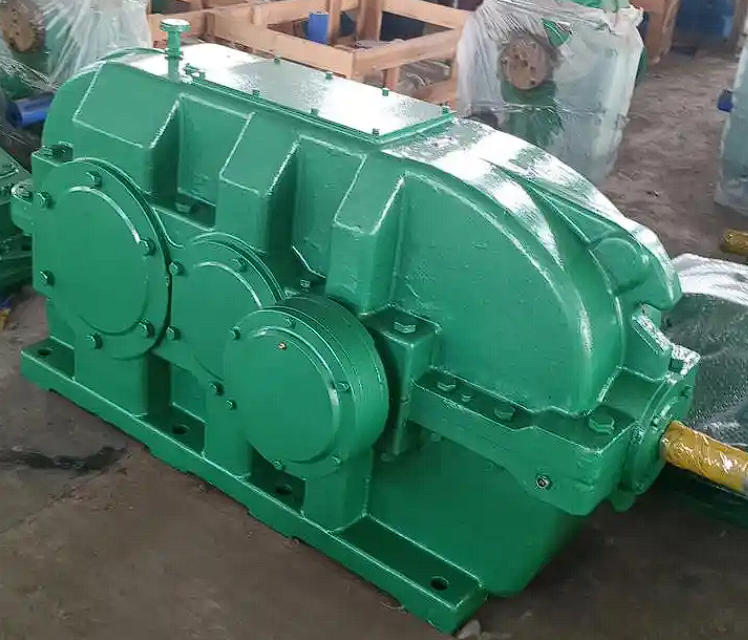
What methods can reduce the cost of gear grinding process for DCY355-25-II reducer
1、 Source margin optimization reduces ineffective grinding hoursStrictly control the common normal clearance of the hot rolling gear, compress the single-sided clearance of the grinding gear from the conventional 0.2mm to 0.12-0.15mm, and directly reduce the grinding time by 30%.
The heat treatment adopts fixture assisted quenching+pre deformation compensation to control the deformation of the gear after carburizing and quenching within 0.08mm, avoiding repeated grinding caused by excessive local allowance.
Using "inner hole+end face" as a unified benchmark for gear hobbing, heat treatment, and grinding, eliminating the accumulation of errors caused by multiple clamping and reducing the time required for alignment and re grinding.
2、 Process path substitution significantly improves processing efficiency
Introducing the hard tooth surface scraping process instead of rough grinding, the metal removal rate is 3-4 times that of ordinary grinding, leaving only 0.05-0.08mm margin for precision grinding, and the total grinding time can be reduced by more than 60%.
For non critical meshing gears with precision requirements of ≤ 7 levels, the "shaving instead of grinding" process is adopted, which improves processing efficiency by 80%, and only retains the full grinding process for high-speed heavy-duty gears.
In small-scale production scenarios, controllable electrolytic honing technology can be used to replace some gear grinding processes, with low equipment modification costs and processing energy consumption only 1/5 of conventional gear grinding.
3、 Optimizing grinding wheels and fixtures to reduce losses of consumables and waste products
For the large modulus gear of DCY355, Norton Xtrimium high-performance molded frosted wheel is selected, which increases the cutting amount by 40%, prolongs the dressing interval by 30%, and doubles the comprehensive service life of the grinding wheel.
Using a 5P five dimensional modular quick change grinding fixture, the changeover time is compressed from 30 minutes to within 5 minutes, and the equipment utilization rate is increased by 20% to 30%. The scrap rate caused by clamping deformation is reduced by 35%.
Optimize the grinding wheel particle size and dressing strategy: 60-80 mesh for rough grinding and 100-120 mesh for fine grinding, dressing every 20-30 pieces, with a dressing depth controlled between 0.002-0.005mm to reduce unnecessary wear and tear on the grinding wheel.
4、 Parameter and energy efficiency control, compression energy consumption, and repair cost
Adopting the layered strategy of "coarse grinding with large feed+fine grinding with small feed", the coarse grinding has a radial feed of 0.03~0.06mm/stroke, and the fine grinding has a radial feed of 0.005~0.015mm/stroke, to avoid tooth surface burn repair caused by blind high feed.
Introducing an adaptive grinding force control algorithm, the energy consumption of a single gear grinding is stably controlled within 1.3 kWh, avoiding the non-linear inflection point where the repair rate doubles after the energy consumption exceeds 1.95 kWh, and the yield rate remains stable at over 92%.
Upgrade the high-pressure cooling system by directly spraying coolant into the grinding contact area, equipped with a three-stage 5-10 μ m filtration device, extending the replacement cycle of grinding oil, reducing oil consumption and waste caused by tooth surface scratches.
Related News