

Comprehensively compare three common industrial reducers and accurately match equipment requirements!
Gear reducers, planetary reducers, and worm gear reducers are currently the three most mainstream reducers in the industrial field. With core functions such as reducing speed, increasing torque, and matching inertia, these three types of reducers are widely used in various industrial manufacturing and mechanical equipment.1、 Gear reducer
Gear reducer is the most fundamental and technologically mature type of reducer. Gear reducers change speed and torque by meshing gears of different sizes and numbers of teeth. The transmission principle of a gear reducer is similar to the chain switching between gears of different sizes when shifting gears on a bicycle. Through clever gear combinations, gear reducers can easily reduce speed and increase torque, meeting the power needs of various industrial equipment.
Gear reducers are like "small motors" in mechanical equipment, converting high-speed input power into low-speed but stronger output power. Compared to other types of reducers, gear reducers have high efficiency, simple structure, and low cost, but their volume is relatively large. Therefore, they are mainly used in ordinary industrial fields such as motors, machine tools, and conveyor belts.
When choosing a gear reducer, it is recommended to mainly consider accuracy, load-bearing capacity, and efficiency.
High precision gear reducers operate more smoothly, with smaller errors and ensuring that the processed products meet the required precision standards. In some heavy machinery, such as mining equipment, a gear reducer with strong load-bearing capacity is required to drive heavy mechanical components to operate stably. Efficient gear reducers can help businesses save a lot of energy costs. Good design and manufacturing processes can reduce friction losses between gears and improve transmission efficiency.
II planetary reducer
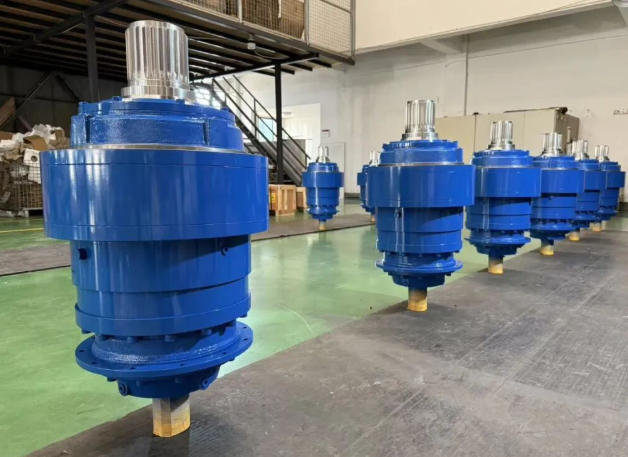
Planetary reducer (planetary gear reducer) is an emerging type of reducer in recent years, with a structure similar to "planets revolving around the sun" (central gear+planetary gear+outer ring gear+inner ring gear+planetary carrier). When the motor or engine drives the sun gear to rotate, the planetary gear rotates around its own axis and also around the inner gear ring, thereby achieving deceleration.
As an emerging type of reducer, planetary gear reducer adopts a unique planetary gear layout, with a more compact structure, high efficiency, high torque, high precision, low noise, small backlash, high output torque, long service life, and excellent impact and overload resistance. It can adapt to various harsh working conditions and meet the needs of high load equipment such as conveyors and elevators in industrial production, as well as high-precision scenarios such as robot joints and CNC machine tools.
When choosing a planetary gearbox, it is recommended to mainly consider the reduction ratio, torque, accuracy, and environmental adaptability.
3、 Worm gear reducer
The worm gear reducer utilizes the meshing between the worm gear and the worm wheel to achieve deceleration and increase torque. Its core feature is that single-stage transmission can achieve a large reduction ratio and has self-locking performance.
In automation equipment, conveying machinery, packaging machinery, elevators, conveyors, and various industrial transmission systems, worm gear reducers convert the high speed and low torque input by the motor into the low speed and high torque required by the output end through their unique worm gear and worm structure, thus meeting the core requirements of equipment for high torque and low-speed driving.
When choosing a worm gear reducer, it is recommended to mainly consider the reduction ratio, output torque, and whether self-locking is needed.