
How to address the issue of abnormal noise and severe vibration during the operation of the YD electric roller
1、 Pre security operation promptsBefore troubleshooting, the main power supply of the equipment must be cut off, a "under maintenance" warning sign must be hung, and the drum must be confirmed to be completely stopped before operation.
It is strictly prohibited to forcibly start and test run with a load to prevent malignant accidents such as cracking of the drum body and gear tooth breakage caused by abnormal noise and vibration.
2、 Step 1: Quickly locate the fault source through abnormal noise characteristics
Continuous rustling and friction sound: Most likely due to bearing lubrication failure or dry wear of seals.
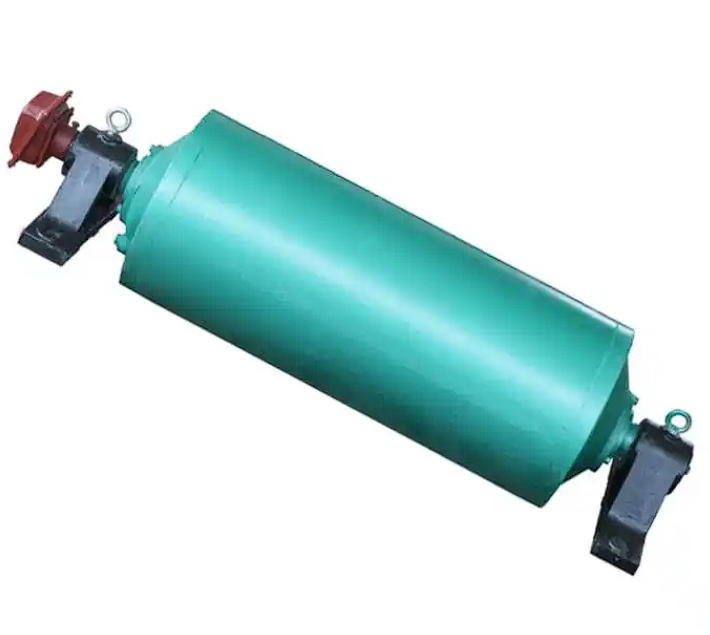
Periodic clattering sound: mostly caused by pitting corrosion of bearing rolling elements, gear tooth breakage, or cylinder eccentricity.
Low frequency clanging sound: mostly caused by loose connecting bolts or failure of shaft and cylinder fit.
Screaming resonance sound: mostly caused by excessive coaxiality during installation, severe deviation of the conveyor belt from the friction end face.
3、 Troubleshooting and resolution of core fault points
1. Bearing faults (accounting for over 60% of abnormal noise and vibration faults)
Check the bearing clearance: Use a dial gauge to measure the radial clearance. If the clearance is greater than 0.3mm, it is directly judged that the wear exceeds the standard.
Solution: Supplement or replace the corresponding brand of lubricating grease. If the wear is severe, replace the bearing directly. Priority should be given to using SKF or NSK brand industrial grade bearings.
Synchronous inspection of seals: When the lip edge of the oil seal is worn or the labyrinth seal is dusty, replace the high-temperature resistant skeleton oil seal to prevent dust from entering and damaging the bearing again.
2. Internal transmission gear failure
Open the end cover to check the gear meshing surface. If the tooth surface is corroded or worn by more than 0.5mm, the gear pair must be replaced.
Adjust the gear mesh clearance again to ensure that it is controlled within the range of 0.2~0.4mm and avoid abnormal noise caused by meshing impact.
Synchronize the inspection of the lubricating oil status in the oil tank, thoroughly replace the oil when metal debris is mixed in, and clean the sediment impurities at the bottom of the oil tank.
3. Failure of cylinder and shaft structure
Use a dial gauge to measure the radial circular runout of the rolling cylinder, and correct the coaxiality of the cylinder when the concentricity deviation is greater than 0.1mm.
Check the bolts, welding seams, and expansion sleeve connection positions of the cylinder shell, re tighten and weld any loose or open welds, and eliminate low-frequency vibrations caused by relative displacement.
Check the bending amount of the drum shaft. If the bending exceeds the standard, perform straightening treatment. If straightening is not possible, replace the shaft directly with a new one.
4. Installation and external connection failure
Recheck the coaxiality of the bearing seats at both ends, calibrate the levelness of the installation surface with a spirit level, and adjust the position of the shim again if it exceeds the tolerance.
Tighten all connecting bolts in diagonal order, and control the torque of the end cap bolts at 20-25N · m to avoid unilateral compression causing unbalanced load.
Check the tension of the conveyor belt and readjust it when it deviates to avoid continuous whistling caused by long-term friction between the belt edge and the roller end face.