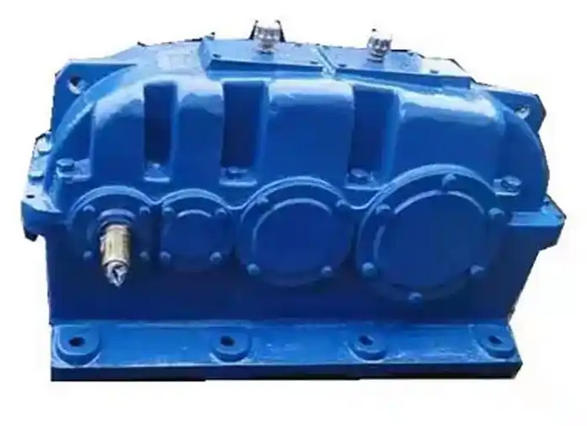

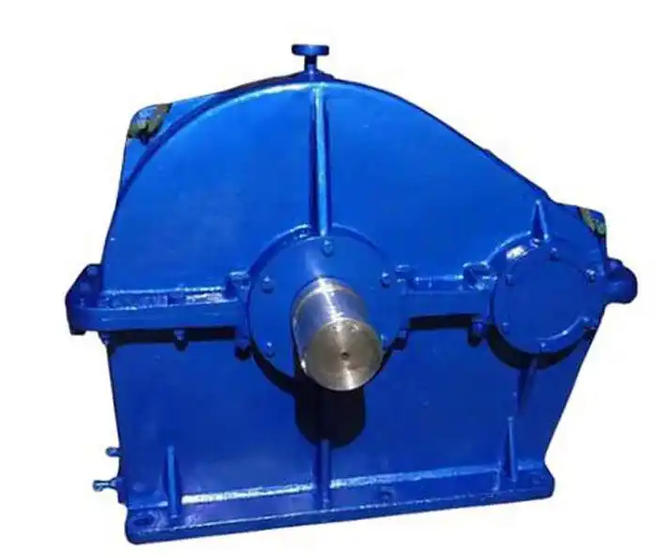
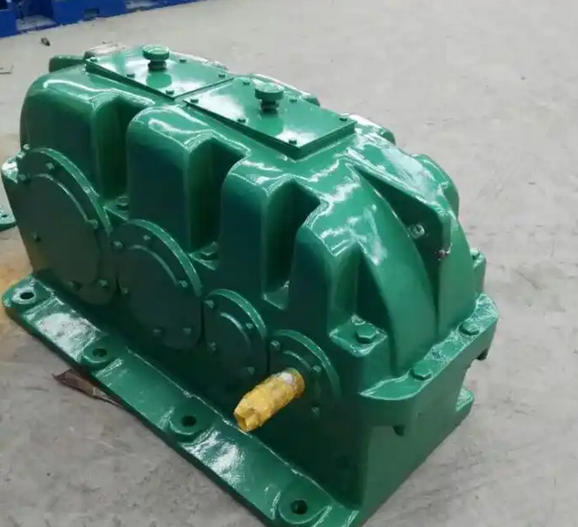
How to reduce the vibration of motors and ZSY180-31.5-II gear reducers
For the vibration control of motors and ZSY180-31.5-II hard tooth cylindrical gear reducers, it is necessary to combine the structural characteristics of the equipment (such as high-speed shaft speed, gear transmission ratio, bearing model, etc.), and systematically solve the problem from the dimensions of installation accuracy, mechanical balance, transmission matching, maintenance optimization, etc. The following are 12 technical measures that can be directly implemented, each of which includes operating standards and implementation details:1、 Installation accuracy control (core foundation)
Reference alignment: coaxiality and parallelism correction of motor reducer
Using a dial gauge or laser centering instrument for precise centering, it is required that the radial displacement deviation be ≤ 0.02mm, the angular displacement deviation be ≤ 0.05mm/m, and the end face clearance of the coupling be uniform (recommended value of 0.2-0.5mm, adjusted according to the coupling model). The installation surface needs to be milled or ground with a flatness of ≤ 0.03mm/m. The anchor bolts should be locked with double nuts and equipped with anti loosening washers. The tightening torque should follow the equipment manual requirements (usually M20 bolt torque is 150-180N · m) to avoid vibration amplification caused by uneven foundations or loose bolts.
Foundation reinforcement and vibration reduction design
The equipment foundation needs to be poured with concrete of C30 or above, with a thickness of ≥ 300mm, and a steel mesh (Φ) should be set at the bottom 12mm@150mm )And reserve anchor bolt holes (depth ≥ 200mm). For vibration sensitive scenarios (such as around precision equipment), rubber damping pads (hardness Shore A 60-80, thickness 20-30mm) or spring dampers can be installed between the reducer base and the foundation, with a damping efficiency of ≥ 80%, while ensuring that there is no rigid connection between the foundation and surrounding structures to avoid resonance transmission.
2、 Mechanical balance optimization (eliminating vibration sources)
Dynamic balance correction of rotor and transmission shaft
The motor rotor needs to achieve G2.5 dynamic balance according to GB/T 9239.1 requirements (allowable unbalance ≤ 2.5g · mm/kg at a speed of 1500r/min), and the input shaft, output shaft, and gear shaft of the reducer need to undergo dynamic balance testing (accuracy G4.0 level). If the vibration is accompanied by periodic abnormal noise, the gear needs to be disassembled and inspected for uneven wear, tooth surface bonding, or broken teeth. After replacing the gear, the mesh clearance needs to be adjusted again (standard clearance 0.15-0.3mm, converted by modulus).
Coupling selection and maintenance
Priority should be given to using elastic couplings (such as plum blossom shaped and claw shaped), whose elastic body can absorb certain vibrations and coaxiality deviations, avoiding the transmission of impact loads by rigid couplings. The elastomer needs to be inspected regularly. If there is aging, cracking, or wear exceeding 3mm, it should be replaced immediately. At the same time, ensure that the tightening torque of the coupling bolts is uniform to avoid eccentric vibration caused by loose bolts.
Related News