
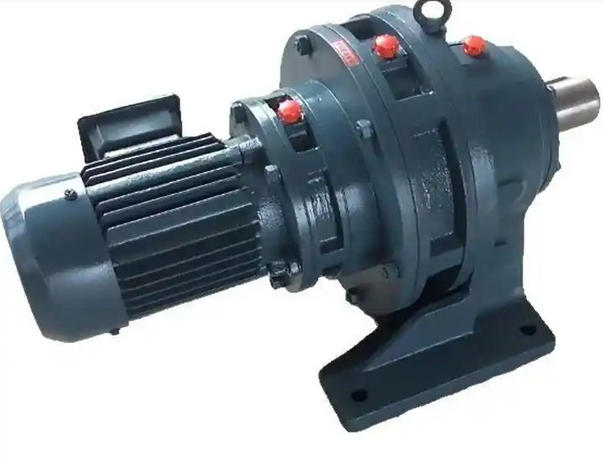
What adjustment steps are required after replacing the cycloidal wheel of BLEY52-841-1.5 reducer?
BLEY52-841-1.5 belongs to a double cycloid gear needle wheel reducer. After replacing the cycloid gear, precise adjustment is required to ensure that parameters such as phase, meshing clearance, and axial displacement meet the requirements, avoiding transmission jamming, excessive noise, insufficient torque, and other faults. The specific adjustment steps are as follows:1. Phase review adjustment
This is the core adjustment step after replacing the cycloidal gear, which directly determines whether the transmission is smooth.
Confirm that the two new cycloid gears are original paired accessories, check the end face markings (arrows, dots, etc.), and fit the two cycloid gears onto the two eccentric sleeves of the output shaft with a 180 ° phase difference according to the markings, ensuring that the tooth peak of one cycloid gear aligns with the tooth valley of the other;
If there is no mark on the cycloid wheel, the two wheels can be manually overlapped, and one of them can be rotated until the tooth profile is completely staggered. Then, they can be separately fitted into eccentric sleeves. When rotating the eccentric sleeve, observe the meshing state between the cycloid wheel and the needle teeth inside the needle tooth housing, and ensure that the tooth surface contacts evenly without any one-sided dead phenomenon.
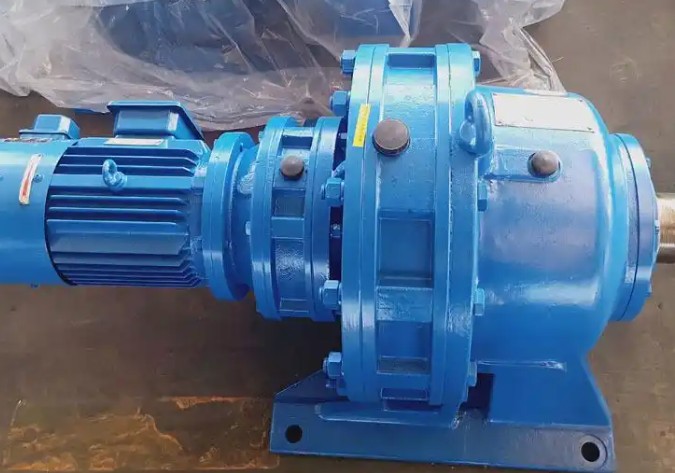
2. Adjustment of meshing clearance
The meshing clearance between the cycloid gear and the needle teeth should be controlled within 0.15~0.3mm (according to the BLEY52 model standard). If the clearance is too large, it can easily produce impact noise, while if it is too small, it can cause operation jamming.
Manually rotate the input shaft and feel the rotational resistance: under normal conditions, it should rotate flexibly without any jerking sensation, and the resistance in both forward and reverse directions should be consistent;
If the rotational resistance is too high, it indicates that the meshing clearance is too small. You can check whether the needle gear pin is worn or deformed, or whether the cycloidal gear is of the compatible model. If necessary, replace the needle gear pin; If the gap is too large, it is necessary to confirm whether there is a machining error in the cycloidal gear and replace it with qualified parts.
3. Axial movement adjustment
Excessive axial movement of the cycloid axle can lead to unstable transmission, while insufficient movement can cause end face friction. It is necessary to control the amount of movement by adjusting the thickness of the gasket.
Before assembling the output flange, install adjustment shims (made of stainless steel or brass) on the end faces of both sides of the cycloidal gear. The standard axial displacement of BLEY52 model is 0.2~0.4mm;
After installing the output flange, manually push the output shaft axially to feel the displacement, or use a dial gauge to measure: place the dial gauge probe on the end face of the output shaft, push and pull the shaft body axially, read the pointer swing value, and increase or decrease the gasket thickness according to the measurement result until the displacement meets the requirements;
When tightening the output flange bolts, it is necessary to apply a uniform cross force with a torque that meets the manufacturer's specifications (generally 12-18N · m) to avoid flange deformation and compression of the cycloidal wheel, which may result in reduced axial clearance.
4. Lubrication system inspection and adjustment
After replacing the cycloidal gear, it is necessary to refill the appropriate lubricating oil to ensure sufficient lubrication of the meshing parts.
Clean up the residual old oil and impurities inside the gearbox, and add specialized lubricating oil for cycloidal pinwheel reducer (recommended brand L-CKC 220 medium load industrial gear oil). The oil level should reach the center line of the oil mark and should not be too high or too low;
If the equipment is used for high temperature or heavy load conditions, extreme pressure gear oil can be added, and the ventilation plug should be checked for smoothness to prevent oil leakage caused by excessive pressure inside the gearbox.
Related News