
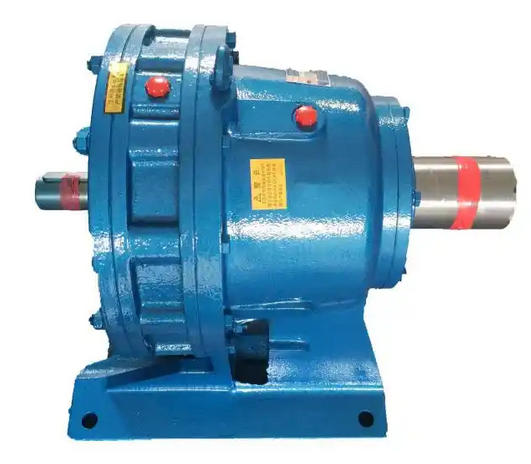
How to determine whether the BW39-11 cycloidal pinwheel reducer needs to be fully disassembled and cleaned
To determine whether the BW39-11 cycloidal pinwheel reducer needs to be fully disassembled and cleaned, a comprehensive judgment should be made based on four indicators: oil state, operating parameters, fault symptoms, and maintenance cycle. When any of the following core situations occur, local flushing should be abandoned and full disassembly and cleaning should be carried out directly. The specific judgment criteria are as follows:1. The oil condition has deteriorated severely, and local flushing cannot cure it
Oil is the main carrier of impurities. When the following problems occur in the oil, it indicates that a large amount of stubborn impurities or deposits have accumulated in the tank, and local flushing is difficult to remove:
Regular oil analysis shows a sudden increase in the content of metal abrasive particles (with iron content exceeding 300ppm), and the abrasive particles are mainly large particles (with a particle size greater than 50 μ m), indicating severe wear inside. The generated metal debris has entered the dead corners of the box, oil passages, or meshing gaps;
The lubricating oil is severely emulsified (with a water content exceeding 0.2%), or there are obvious gel like deposits and black sludge. When draining the oil, it can be seen that the oil is in a paste like state. After multiple replacements with new oil, the oil is contaminated again within a short period of time (7-15 days), indicating that a large amount of sediment remains in the tank and continues to contaminate the new oil;
The magnetic plug of the oil drain port adsorbs a large amount of metal debris (covering more than 60% of the end face of the plug), or there are block shaped metal particles, indicating that there may be internal faults such as component peeling and tooth breakage, and the debris has penetrated into the clearances of each transmission pair.
2. Continuous abnormal operation parameters, no improvement after excluding external factors
If there are abnormal parameters such as vibration and temperature during the operation of the reducer, and external factors such as insufficient lubrication, excessive load, and incorrect shaft system have not been relieved, it indicates that internal impurities have caused abnormal wear or jamming of the components, and full disassembly and cleaning are required:
The vibration value significantly exceeds the standard, and the effective value of the vibration velocity measured at the output bearing seat continues to exceed 3.5mm/s (far exceeding the normal limit of 2.8mm/s for cycloidal pinwheel reducers). Spectral analysis shows that the amplitude of the cycloidal gear meshing frequency has increased by more than twice, accompanied by irregular harmonics, and it is suspected that impurities are causing uneven meshing clearance;
The oil temperature rises abnormally. Under rated load and normal heat dissipation conditions, the lubricating oil temperature continues to exceed 85 ℃, and the shell temperature exceeds 75 ℃. After cleaning the cooler and replacing with new oil, the oil temperature still rises rapidly, indicating that impurities have entered the bearing raceway or meshing area, exacerbating friction and heat generation;
Abnormal operating noise, with obvious "rustling" friction sound, "clicking" jamming sound, or noise that increases by more than 15dB compared to the reference value during no-load operation, and the noise increases with running time, suspected of impurities jamming the meshing gap between the cycloidal gear and the needle pin.
Related News