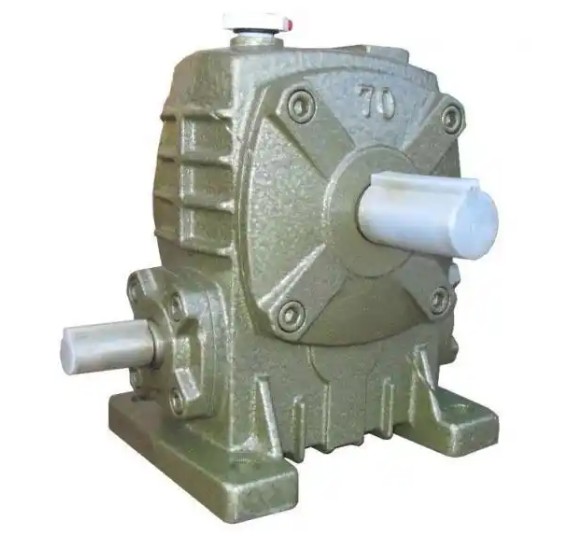


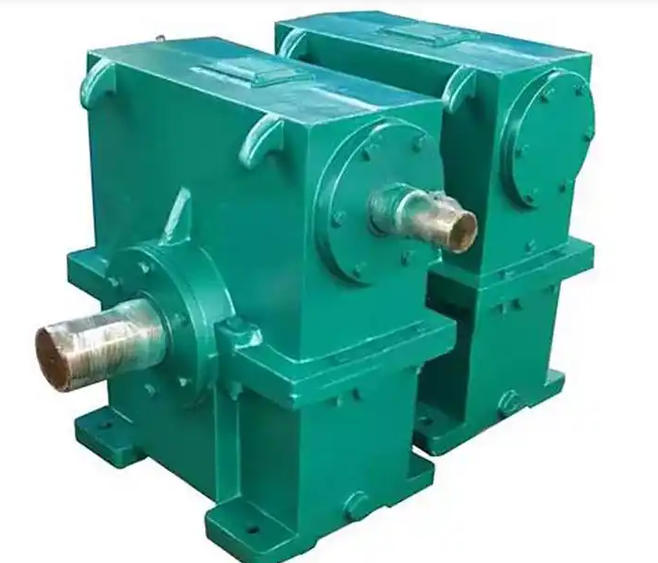
WS180-37-11 worm gear reducer performance parameters detailed explanation
According to the naming convention of worm gear reducers, each digit in WS180-37-11 corresponds to a core technical parameter. WS180 stands for the center distance of 180 mm, which refers to the distance between the worm axis and the worm wheel axis. As a fundamental indicator, center distance directly determines the overall dimension and load capacity of the reducer.
The number 37 in the model represents the transmission ratio of 37, meaning the ratio of worm rotating speed to worm wheel rotating speed. When the worm runs at 1500 r/min, the theoretical output speed of the worm wheel is about 40.54 r/min.
For this model, the maximum allowable input speed of the worm is generally limited to 1500 r/min. In practical projects, users need to select matched motors carefully to guarantee that the input speed stays within the rated range.
The output torque can be calculated using the formula: Input Torque × i × η, where i is transmission ratio and η is transmission efficiency. Without specific input power data, accurate torque values cannot be calculated. As a general rule, reducers with larger center distance and higher transmission ratio can deliver greater output torque.
WS series worm gear reducers feature a transmission efficiency ranging from 60% to 80%. Real efficiency is affected by manufacturing precision, lubrication conditions and actual load. Since WS180-37-11 has a relatively large transmission ratio of 37, its efficiency tends to be lower in this interval, roughly 60% to 70%.
The load capacity relies on raw material, gear module and lubrication state. Equipped with a 180 mm center distance, WS180-37-11 provides reliable load performance and is suitable for medium-load applications.
Moment of inertia reflects the rotational inertia of moving parts. This parameter exerts an obvious impact on the startup and braking performance of the whole transmission system.
The weight of WS180 reducer ranges from 263 kg to 295.5 kg. The actual weight may change due to different manufacturers, fabrication processes and optional configurations.
Regarding operating conditions, the sliding speed at the worm meshing area must not exceed 7.5 m/s. Its applicable ambient temperature is from -40℃ to +40℃, and it supports both forward and reverse rotation. If the working temperature exceeds this scope, extra cooling or heating arrangements should be adopted.
Related News