
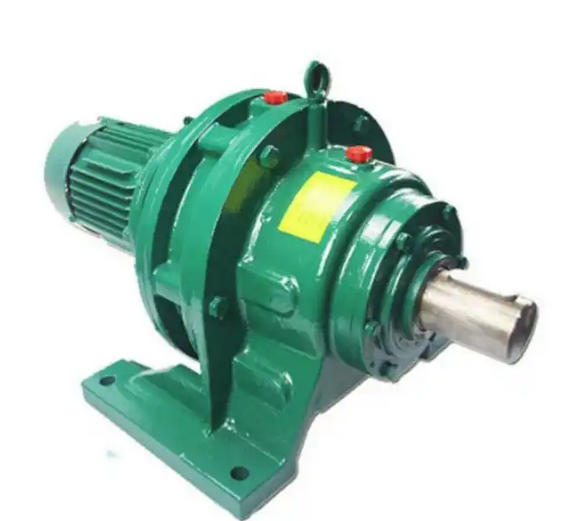
Does the deformation of the cycloidal gear of XWDY8195-17 reducer affect its use
The deformation of the cycloidal gear of XWDY8195-17 reducer will inevitably affect its use, causing abnormal noise and increased wear at a mild level, and directly leading to transmission failure and damage to the whole machine at a severe level. Moreover, the transmission ratio of this model of reducer is 17, which belongs to the medium speed adaptation type. As the core transmission component, the cycloidal gear is more sensitive to deformation and has a greater impact on meshing accuracy. The specific impact is gradually aggravated in three levels:1. Slight deformation (within tolerance, 0.01~0.03mm): The core affects the meshing accuracy, with uneven clearance between the cycloidal gear and the needle teeth, resulting in slight periodic abnormal noise, which is obvious under no-load and slightly weakened after load; The contact area of the tooth surface decreases, the local contact stress increases, and premature wear and pitting of the cycloidal gear tooth surface and needle gear sleeve occur, shortening the service life of vulnerable parts; The transmission efficiency has slightly decreased, accompanied by slight vibrations and no significant temperature rise. It can barely operate in the short term, but needs to be detected and corrected as soon as possible.
2. Moderate deformation (beyond tolerance, 0.03~0.08mm): abnormal noise and vibration intensify, and increase significantly with the increase of speed. When the load is running, the vibration is transmitted to the whole machine, causing base resonance; Serious meshing bias load, with some tooth surfaces experiencing tooth biting, and stress concentration at the tooth top or root, leading to tooth surface peeling and angle collapse; The transmission efficiency has significantly decreased, and the temperature rise of the gearbox housing has accelerated (with no load temperature rise exceeding 8 ℃ and load temperature rise exceeding 15 ℃). At the same time, it will also affect the coaxiality of the output shaft and needle frame, resulting in uneven bearing force, bearing abnormal noise, and jamming.
3. Severe deformation (>0.08mm, including warping and twisting): Direct loss of normal transmission ability, jamming and locking during meshing, difficulty in manual turning; The deformation of the cycloidal gear can compress the needle teeth, causing the needle tooth sleeve to rupture, the needle tooth shaft to bend, and even damaging the needle tooth frame; Severe unbalanced load can cause force imbalance between the input and output shafts, leading to oil leakage at the shaft end and damage to the coupling. In extreme cases, the cycloidal gear may break due to stress concentration, and fragments may damage the internal cavity of the reducer, causing the entire machine to be scrapped and unable to continue operating.
Related News