
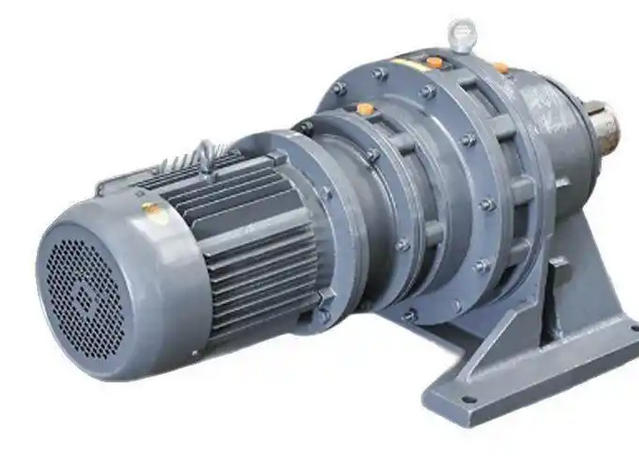
Safety Hazards and Operational Risks of Self-Locking Failure in RV110-40-1.1KW Reducers
The failure of the self-locking performance in an RV110-40-1.1KW worm gear reducer can trigger severe chain reactions, leading to safety hazards, production downtime, equipment degradation, and escalated operational costs. The specific consequences are detailed as follows:
1. Prominent Safety Risks
In lifting and elevating applications that rely on self-locking to prevent reverse movement, a failure can cause unbraked load slippage or drops, potentially resulting in severe equipment damage, workpiece destruction, or even casualties. In precision positioning scenarios, such as photovoltaic tracking brackets or packaging machinery, the output shaft may experience positioning drift due to load reversal after shutdown. This can lead to device collisions, misalignment of solar panels, and secondary safety incidents like short circuits or medium leaks caused by uncontrolled tension on pipeline cables.
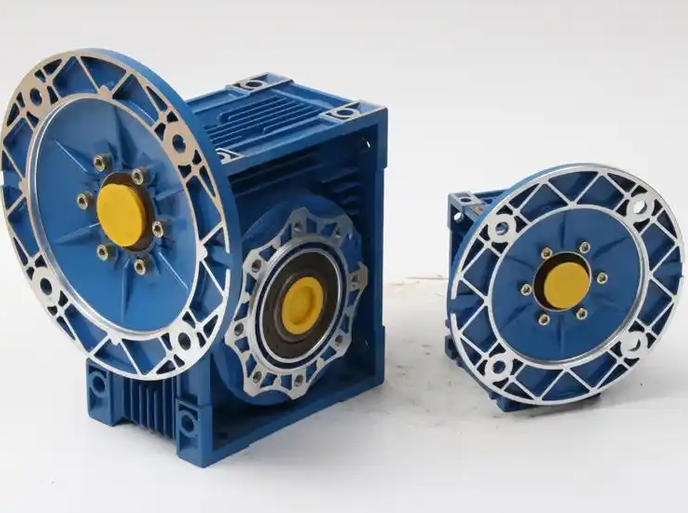
2. Production Interruptions and Loss of Process Accuracy
A self-locking malfunction necessitates emergency shutdowns for troubleshooting, halting the production line and directly impacting efficiency and order fulfillment. In high-precision tasks like packaging and indexing, positioning drift causes tape misalignment and dimensional deviations, significantly increasing the scrap rate and compromising process stability. Furthermore, correcting these deviations requires repeated motor start-stop cycles, which not only increases energy consumption but also exacerbates mechanical fatigue in both the motor and the reducer, creating a vicious cycle.
A self-locking malfunction necessitates emergency shutdowns for troubleshooting, halting the production line and directly impacting efficiency and order fulfillment. In high-precision tasks like packaging and indexing, positioning drift causes tape misalignment and dimensional deviations, significantly increasing the scrap rate and compromising process stability. Furthermore, correcting these deviations requires repeated motor start-stop cycles, which not only increases energy consumption but also exacerbates mechanical fatigue in both the motor and the reducer, creating a vicious cycle.
3. Equipment Damage and Performance Deterioration
The reverse impact of the load can cause plastic deformation and tooth breakage in the worm gear, while axial movement increases bearing clearance and accelerates wear rates by 30% to 50%. Continuous reverse torque may also bend the worm shaft, wear the gear shaft neck, and destroy transmission geometry accuracy, leading to box vibration and abnormal noise. In severe cases, this can cause worm fracture. Additionally, intensified vibration accelerates the aging and leakage of sealing components, resulting in lubricating oil loss or contamination. This further reduces the friction coefficient of the tooth surfaces, exacerbating the self-locking failure and forming a closed-loop cycle of "failure leads to more wear, which leads to more failure."
The reverse impact of the load can cause plastic deformation and tooth breakage in the worm gear, while axial movement increases bearing clearance and accelerates wear rates by 30% to 50%. Continuous reverse torque may also bend the worm shaft, wear the gear shaft neck, and destroy transmission geometry accuracy, leading to box vibration and abnormal noise. In severe cases, this can cause worm fracture. Additionally, intensified vibration accelerates the aging and leakage of sealing components, resulting in lubricating oil loss or contamination. This further reduces the friction coefficient of the tooth surfaces, exacerbating the self-locking failure and forming a closed-loop cycle of "failure leads to more wear, which leads to more failure."
4. Significant Increase in Maintenance and Management Costs
Initially, the issue may only require replacing vulnerable parts like the worm gear or worm. However, if left unaddressed, the fault can propagate to bearings, shafts, and eventually the entire machine, driving maintenance costs to 5 to 10 times the initial preventive expenses. Moreover, equipment failures elevate safety management and compliance risks, forcing companies to invest substantially more manpower and resources into safety rectifications and extensive equipment maintenance.
Initially, the issue may only require replacing vulnerable parts like the worm gear or worm. However, if left unaddressed, the fault can propagate to bearings, shafts, and eventually the entire machine, driving maintenance costs to 5 to 10 times the initial preventive expenses. Moreover, equipment failures elevate safety management and compliance risks, forcing companies to invest substantially more manpower and resources into safety rectifications and extensive equipment maintenance.
Related News