
Common causes and corresponding maintenance solutions for loose fit between the output shaft and coupling of BWD2-29-3KW cycloidal reducer
2、 5 common reasons for cooperating with looseness1. Installation and locking failure: The coupling top thread/locking bolt is not tightened to the specified torque, and the thread becomes loose under long-term vibration; The flat key is not fully embedded in the keyway, resulting in axial movement.
2. Excessive wear of mating surface: The output shaft neck has been subjected to alternating torque wear for a long time, resulting in a diameter reduction of over 0.03mm; the inner hole of the coupling has been worn out of roundness, and the mating clearance has transitioned from standard H7/k6 to clearance fitting.
3. Key connection damage: The flat key undergoes rounding and shear deformation under impact load, and the keyway sidewall is squeezed and cracked, making it unable to transmit rated torque.
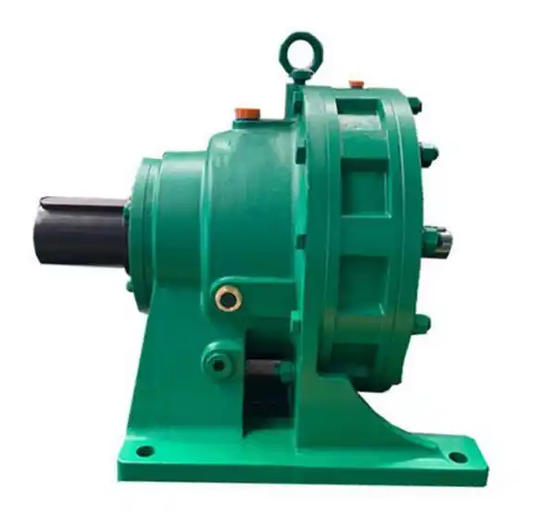
4. Serious coaxiality exceeding the standard: During installation, the radial runout of the two shafts exceeded 0.15mm, generating additional radial impact force during operation, repeatedly impacting the mating surface, resulting in rapid wear and looseness of the mating surface.
5. Overload impact under working conditions: The frequent forward and reverse rotation of the equipment and the instantaneous impact load far exceed the rated torque of 3KW, resulting in plastic deformation of the mating surface between the coupling and the shaft, ultimately leading to looseness.
3、 Corresponding graded maintenance plan
1. Slight looseness (only locking failure, no wear on the mating surface)
Clean the oil and rust stains on the mating surface of the output shaft and coupling, and apply medium strength thread locking adhesive to the threads.
Use a torque wrench to tighten the locking bolt/top screw diagonally and step by step according to the recommended value of 45~60N · m, ensuring even force distribution.
Use a dial gauge to check the radial and end face runout of the coupling, controlling the runout to be ≤ 0.05mm. After completion, manually turn the disc to confirm that there is no jamming during rotation.
2. Slight wear of the shaft neck (wear amount ≤ 0.05mm)
Using the electric brush plating process, a layer of wear-resistant metal is plated on the surface of the output shaft neck to restore the shaft diameter to the original standard size (the standard shaft diameter of the BWD2 model output shaft is φ 35mm).
After plating, finely grind the shaft neck to ensure a surface roughness Ra ≤ 1.6 μ m and restore the H7/k6 transition fit accuracy with the coupling inner hole.
3. Wear of coupling inner hole/damage of keyway
Directly replace the standard coupling with the same specifications, and choose the expansion sleeve keyless type as the priority. It can achieve uniform clamping without slotting, and the centering accuracy is much higher than that of ordinary flat key couplings.
If emergency repair is required on site, a 45 # quenched and tempered steel variable diameter liner can be customized. The liner and coupling inner hole adopt H7/S6 interference fit, and the liner inner hole is adapted to the output shaft diameter. The liner wall thickness is ≥ 3mm to avoid cracking under heavy load.
4. The keyway is severely cracked and deformed
Use an angular grinding wheel to polish and clean the damaged old keyway on the output shaft, and re mill a new standard keyway at a 90 ° position on the original keyway to avoid residual cracks in the old keyway affecting strength.
Replace the standard flat key with a new one, and control the clearance between the flat key and the keyway on both sides to be 0.01~0.03mm, with a reserved thermal expansion gap of 0.2~0.4mm at the top.
5. Severe wear (journal wear exceeding 0.1mm or plastic deformation)
It is strictly prohibited to directly turn the quenched output shaft to avoid damaging the surface heat treatment layer and causing the shaft strength to be scrapped.
Adopting the hot sleeve process to install wear-resistant steel shaft sleeves in the wear section of the output shaft, the shaft sleeve and shaft are fitted with interference fit, and after press fitting, the outer circle of the shaft sleeve is re machined to the standard shaft diameter, and then the coupling is installed.