
How to determine if the WP series worm gear reducer is installed properly
1、 Static accuracy verificationBasic levelness meets the standard: Use a level with an accuracy of 0.02mm/m to detect the longitudinal and transverse levelness of the top of the box. Adjust the gasket to control the error ≤ 0.05mm/m, and there is no suspended gap between the base and the foundation.
Axis alignment qualified: Use a dial gauge to measure the radial deviation between the input shaft and the motor shaft to be ≤ 0.1mm, and the end face runout to be ≤ 0.05mm; the coaxiality deviation between the output shaft and the load shaft to be ≤ 0.15mm.
All fasteners are locked: Use a torque wrench to tighten the anchor bolts in diagonal order, with a torque controlled between 80-120N · m, and ensure that all connecting bolts are not loose or loosely locked.
Installation of transmission components in place: The sprocket, gear and other transmission components on the output shaft should be pressed into place with assembly fixtures, and should not be knocked. They should be installed as close as possible to the bearing to reduce shaft bending stress.
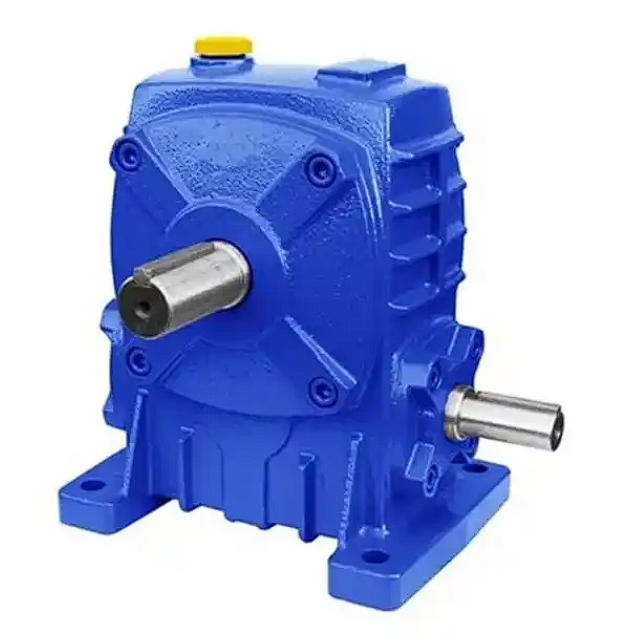
2、 Manual turning inspection
Disconnect the motor power supply and manually rotate the input shaft. The entire rotation should be flexible without any jamming or jerking, and the driver's feel should be uniform and consistent in both forward and reverse directions.
There is no abnormal scraping sound in the meshing of the worm gear, and there is no abnormal sound of metal impact throughout the entire turning process. The backlash angle meets the design standards of this model, and there is no obvious clearance.
The output shaft rotates smoothly with the input shaft synchronously, without slipping or jamming, and the transmission chain has no additional resistance throughout the entire process.
3、 No load trial operation verification
Run continuously without load for more than 2 hours, with smooth operation throughout the entire process, no impact, no abnormal vibration, and a double amplitude vibration of ≤ 0.05mm in the middle of the shell.
The running sound is a uniform and soft "buzzing" meshing sound, without sharp metal scraping sound, periodic impact sound or high-frequency whistling.
There is no oil leakage or seepage at the sealing points and box joint surfaces, and only a small amount of oil film is allowed to infiltrate the oil seal lip.
The temperature of the bearing seat is ≤ 75 ℃, the temperature difference between the oil pool oil temperature and the environment is ≤ 35 ℃, and there is no local overheating phenomenon.
After the trial run, all fasteners were not loose, and the oil level remained stable at 1/2~2/3 of the oil window height without any abnormal changes.
Related News