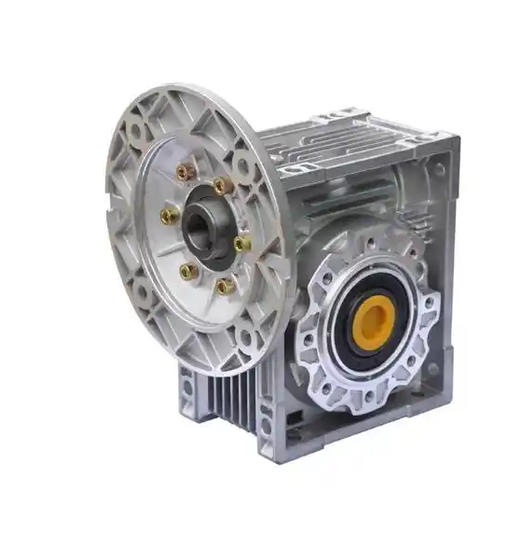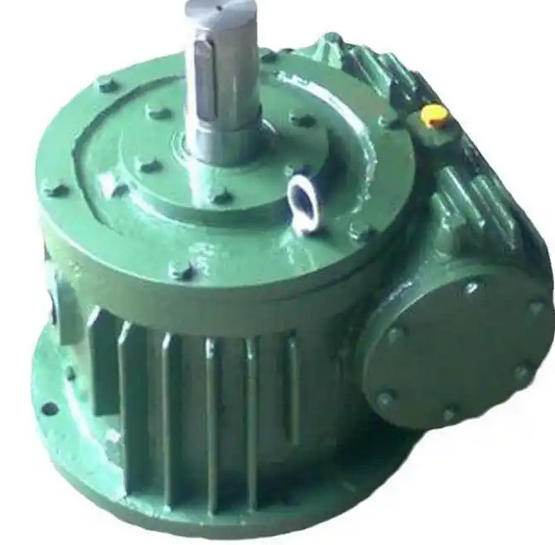


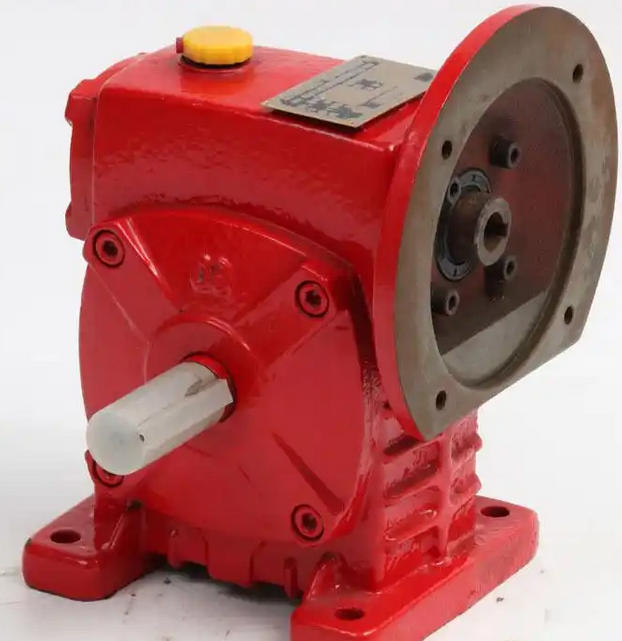
How to determine whether the contact spots of the worm gear and worm of WPDS120-1:25-B reducer are qualified
The qualified judgment method for the contact spot of the worm gear and worm gear of WPDS120-1:25-B reducer is as follows:1. Preparation before testing
1.1 Disassemble the reducer end cover, remove the worm gear, clean the oil stains and iron filings on the tooth surface with kerosene or diesel, and ensure that the tooth surface is free of impurities after drying.
1.2 Apply red lead powder or blue oil evenly on the surface of the worm gear teeth, with a coating thickness controlled at 0.005-0.01mm, to avoid covering the true contact state with excessive thickness.
1.3 Reinstall the worm gear and worm to the meshing position, slowly rotate the worm shaft by hand, rotating 3-5 turns in both directions, leaving clear contact marks on the worm gear teeth surface.
2. Core indicators for qualification determination
2.1 Contact position: The contact spot is located in the middle of the worm gear tooth surface, slightly offset from the direction of worm rotation, and must not be biased towards the tooth tip, tooth root, or the edges of both ends of the tooth.
2.2 Proportion of contact area: The quenched and tempered worm gear has a contact area of ≥ 60% in the tooth length direction and ≥ 50% in the tooth height direction; Quenching and grinding high-precision worm gear, with tooth length direction ≥ 70% and tooth height direction ≥ 60%; The reduction ratio of 1:25 for this model is a medium speed ratio working condition, and the contact area can be appropriately relaxed by 5% -10%, but not lower than the minimum standard.
2.3 Contact shape: The contact spots are continuous and uniform in the form of strips or sheets, without obvious interruptions or scattered spots.
3. Unqualified situation and handling
3.1 Deviation towards tooth tip: The center distance is too large, adjust the thickness of the bearing seat gasket.
3.2 Deviation towards tooth root: The center distance is too small, increase the thickness of the gasket.
3.3 Deviation towards the tooth end: If the two axes are not parallel, correct the coaxiality of the installation.
3.4 Insufficient contact area: Adjust by manually grinding or scraping the tooth surface with fine sandpaper; If it still does not meet the standard, check the tooth profile accuracy and replace the components if necessary.
3.5 Scattered and discontinuous spots: The tooth profile error is large and needs to be reprocessed or replaced.
3.6 Localized dense spots: There are hard spots or deformations on the tooth surface, which need to be polished.
4. Additional precautions
4.1 During testing, ensure that the installation posture of the worm gear is consistent with the actual working state to avoid misjudgment caused by assembly deviation.
4.2 If the contact spot is qualified, but there is obvious wear and peeling of the worm gear and worm gear, the parts still need to be replaced and cannot be continued to be used.