
What specific impacts does the manufacturing accuracy of the housing have on the heat dissipation effect of the reducer
1、 The direct impact of bearing hole accuracy on heat dissipationWhen the coaxiality and roundness deviation of the bearing hole exceed 0.02mm, it will damage the fit between the outer ring of the bearing and the hole wall, significantly increase the contact thermal resistance, and the heat generated by the operation of the bearing cannot be quickly conducted to the wall of the box. The local hot spot temperature can be 15-20 ℃ higher than the normal value.
The deviation of the center distance of the bearing hole exceeds 0.05mm, which will cause the center distance of the gear pair to shift, abnormal meshing backlash of the tooth surface, significant increase in sliding friction loss, and the additional heat generated will increase the steady-state temperature rise of the whole machine by 8-12 ℃.
Insufficient accuracy in the cylindricity of bearing holes can cause uneven distribution of bearing clearance, local overload friction and heat generation of rolling elements. Under long-term operation, the oil temperature in this area will be higher than other positions by more than 10 ℃, accelerating the oxidation and deterioration of lubricating oil.
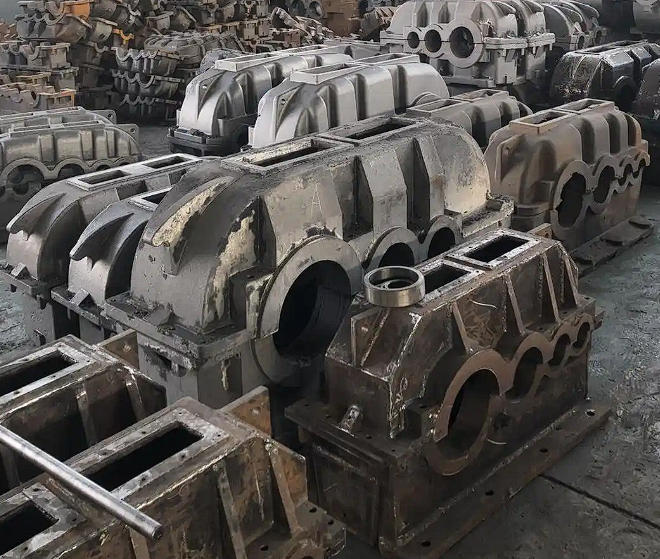
2、 The influence of the precision of the box joint surface on heat dissipation
When the flatness of the joint surface of the split box exceeds 0.03mm, the gap between the upper and lower boxes increases, and even if sealant is applied, intermittent air insulation layers will be formed. The thermal conductivity efficiency at the joint surface decreases by more than 30%, hindering the uniform diffusion of heat on the box wall.
Poor adhesion of the joint surface can cause leakage during operation, resulting in a decrease in the lubricating oil level and a weakened cooling effect of gear stirring. At the same time, the leaked oil accumulates on the surface of the box to form an oil insulation layer, further reducing the convective heat dissipation efficiency of the box surface.
Insufficient positioning accuracy during box assembly processing can cause misalignment of the bearing holes in the upper and lower boxes, intensify vibration during shaft operation, and convert additional vibration energy into heat, resulting in an increase of about 10% in the overall thermal load of the machine.
3、 The influence of internal and external structural accuracy on heat dissipation
If the inner cavity of the box is not cleaned after casting, residual sand and burrs on the inner wall will increase the flow resistance of lubricating oil in the box, hinder the convective heat transfer of hot oil to the box wall, and reduce the ability of the oil to carry heat. Heat is easily accumulated locally in the meshing area.
The processing accuracy of external heat dissipation ribs is insufficient, and there is casting sand adhesion, uneven thickness or layout misalignment at the root of the ribs, which will directly reduce the effective heat dissipation area, damage the preset air convection channel, reduce the natural convection heat dissipation efficiency by 20%~25%, and the steady-state oil temperature can be 7 ℃ higher than the design value.
The accuracy of the uniformity of the wall thickness of the box is out of control. If the local wall thickness is too thin, it will reduce the overall heat capacity of the box. During operation, the temperature rise rate on the surface of the box is significantly accelerated, and it is difficult to buffer the instantaneous heat load fluctuations through its own heat storage, which can easily lead to short-term overheating.
4、 The indirect impact of heat generation increment caused by precision deviation on heat dissipation
Insufficient accuracy of the casing leads to excessive coaxiality of the shaft system, causing gear meshing contact spots to shift to the tooth end, resulting in significantly increased frictional losses due to tooth surface offset load. This additional heat generation far exceeds the carrying capacity of the original heat dissipation system of the casing, forming a vicious cycle of "poor accuracy → high heat generation → temperature rise → further damage to accuracy due to thermal deformation".
The accuracy deviation of the positioning hole in the box causes poor alignment between the shaft system and the motor, and additional friction heat is generated at the coupling. The heat is conducted along the shaft to the inside of the reducer, which is equivalent to adding an external heat source and further raising the operating temperature of the whole machine.
Related News