
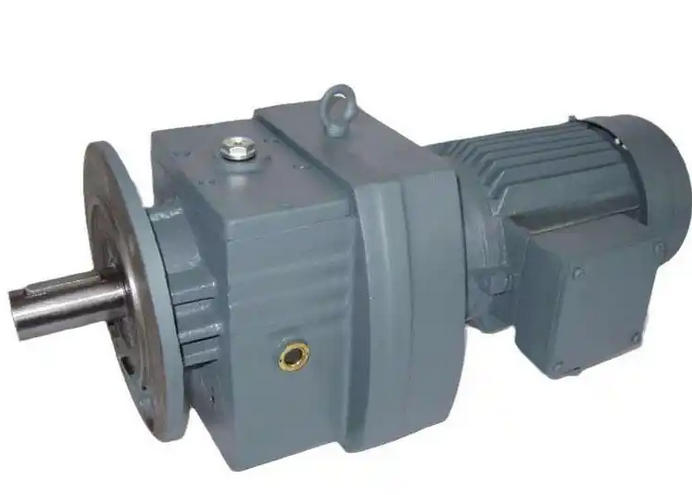
Why do high-speed sizing machines prefer helical gear reducers?
1. The transmission is extremely smooth, significantly reducing vibration and noiseThe tooth profile of helical gears is spiral and progressive during the meshing process. The contact wire starts from the tooth end, gradually extends to the entire tooth width, and then slowly exits. This gradual bonding method, similar to a zipper, completely avoids the hard collision caused by the instantaneous full tooth width impact of spur gears, thereby greatly reducing vibration and noise during operation. For high-speed sizing machines, this not only ensures the smooth operation of the equipment, but also fundamentally reduces equipment wear and tear caused by vibration, extending the service life of the entire machine.
2. Strong load-bearing capacity, capable of handling high load conditions with ease
Due to the helix angle design of helical gears, they often have two or even three sets of teeth simultaneously subjected to force during operation, resulting in a much higher degree of coincidence than spur gears. This reduces the unit tooth surface pressure and significantly improves the load-bearing capacity (usually by 15% to 20%). In addition, with hard tooth surface treatment (such as carburizing and quenching), the wear resistance and fatigue strength of the gear are greatly improved, making it easy to cope with the wear challenges caused by continuous high load operation of the sizing machine.
3. High transmission efficiency, supporting high-speed continuous operation
The transmission efficiency of helical gear reducers is extremely high, usually reaching 94% to 98%. Its diagonal contact line can effectively disperse frictional heat, resulting in a lower temperature rise during continuous operation (usually around 30 degrees), ensuring stable operation of the equipment at high speeds (500 to 5000 rpm). It is very suitable for production scenarios such as sizing machines that require long-term continuous operation.
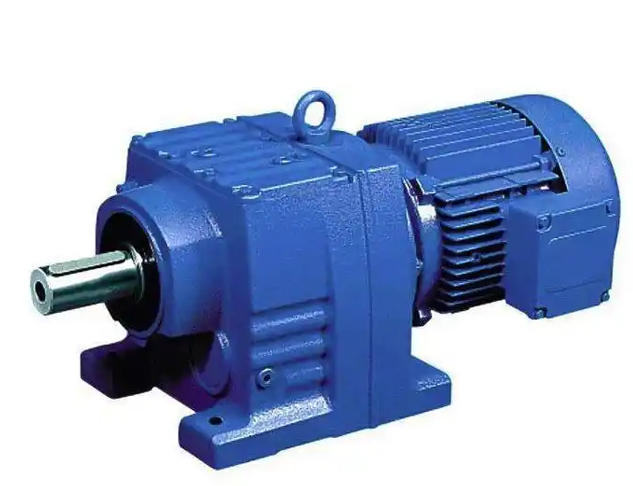
4. Compact structure and longer lifespan
Compared to spur gears, helical gear mechanisms are more compact, smaller in size, and lighter in weight. Meanwhile, due to the smooth meshing process, the risk of pitting corrosion on the tooth surface is greatly reduced. Actual test data shows that after 2000 hours of operation, the transmission efficiency of the equipment deteriorates very little (only about 0.3%), which means that the maintenance cycle of the equipment is longer and the overall cost of use is lower.
5. Excellent environmental adaptability
High quality helical gear reducers (such as hard tooth surface reducers) have been specially optimized in terms of box rigidity and sealing structure to address complex environments such as multi fiber fly in and temperature and humidity changes in textile workshops. This can effectively prevent fly in and oil leakage problems, ensuring the long-term stable operation of core power components.
Structural trade-offs to be noted:
Although helical gears have significant advantages, their helix angle generates a certain axial force during rotation. Therefore, when designing the transmission system of a high-speed sizing machine, it is necessary to additionally configure angular contact bearings or tapered roller bearings to support and counteract this lateral impact, in order to ensure that the shaft system does not deviate.
Related News