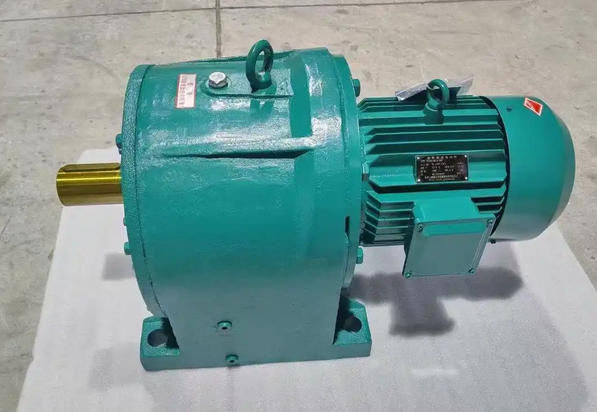

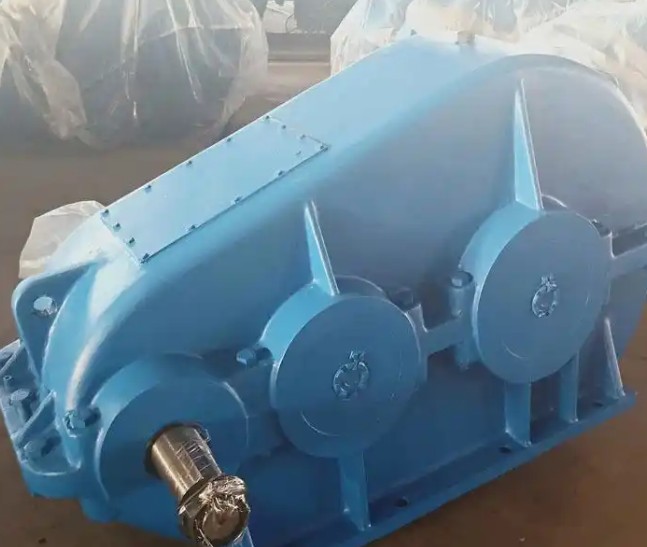
How to determine whether the JZQ400-48.57-2 reducer has passed the trial operation
To determine that the JZQ400-48.57-2 reducer has passed the no-load test run, comprehensive verification is required from three dimensions: operating status, key parameters, and component status. Only when all of the following criteria are met can it be judged as qualified, as follows:1. Operation status determination
1.1 The direction of operation is consistent with the body identification, and there is no reverse operation.
1.2 The entire operation runs smoothly without any abnormal sounds such as metal impact, sharp whistling, or continuous friction, only with uniform gear meshing sound.
1.3 Manually rotate the input shaft (once before and once after trial operation), with flexible rotation, no jamming, and no obvious gap changes. The number of rotations should not be less than 3.
2. Key parameter determination
2.1 Temperature index: Bearing temperature rise ≤ 40 ℃, absolute temperature ≤ 75 ℃; The shell temperature is uniform and there are no localized overheating areas.
2.2 Vibration index: The vibration speed of the shell is ≤ 2.8mm/s, and the vibration value is stable during operation without sudden increase.
2.3 Noise index: measured at a distance of 1m from the reducer, the noise during no-load operation is ≤ 85dB, and there is no periodic abnormal noise.
3. Component status determination
3.1 Sealing state: There is no oil leakage or seepage at the joint surfaces, oil seals, oil gauges, and breathable plugs.
3.2 Connection status: All fasteners such as anchor bolts, coupling bolts, and end cap bolts are not loose, and the anti loosening device is intact.
3.3 Lubricating oil status: The oil level should be maintained within the range of 1/2~2/3 of the oil gauge, and the oil should not have blackening, emulsification, or odor. After sampling and settling, there should be no obvious metal debris.
Related News